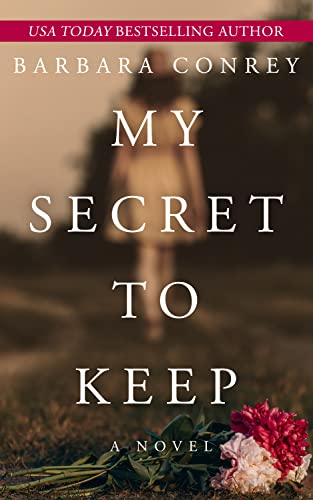
It is my pleasure to welcome Barbara Conrey to The Writer is a Lonely Hunter once again. We first met online in 2021 when she was kind enough to answer questions about her debut novel Nowhere Near Goodbye. (You can find the piece here.) She now has a splendid second novel released with the evocative title My Secret to Keep. This fascinating story made me wonder about Barbara’s writing process which she explains in this author interview. But first, here is some information about the novel:
When Maggie Bryan works up the nerve to tell her parents she’s pregnant, they immediately disown her. Later that night, her boyfriend is killed. In desperation, she turns to her brother, Sam. Against his wife’s wishes, Sam brings Maggie to his home in rural Pennsylvania.
While Maggie awaits the birth of her child and navigates the tension in her new home, she decides to finish high school. There, she meets Anne Phillips, a volunteer educator and full-time architect. Over time, Maggie becomes drawn to Anne in ways she doesn’t understand, but she knows enough to keep her feelings hidden.
After a devastating loss, Maggie tries to move on, but secrets and betrayals keep her from living her fullest life. Beginning in the late 1940s and spanning decades, My Secret to Keep portrays a woman at war with society, her family, and herself.

And now to the questions:
How much planning was involved in writing a novel that spans decades?
Writing a novel that spans decades is eerily similar to those blasted reading math problems when I was in grade school – and I wasn’t very good at them then, either. So there’s a lot of counting forwards and backward and practically using my fingers to ensure I’ve got my timelines right.
The blurb describes Maggie as a woman at war with society, her family, and herself. This so clearly describes the protagonist, and yet she achieves acceptance too. Did you know what would happen at the end of the novel when you started writing the book?
The ending of this book nearly did me in because Maggie only achieved acceptance, and by this, I mean accepting herself after she lost Anne. I was devastated.
You cleverly dovetailed the latter part of the novel with the story in your debut, Nowhere Near Goodbye. This gave me the chance to reconnect with Kate’s story. Was this your intention?
Most people don’t know that once Nowhere Near Goodbye was under contract, I had to rewrite a good half of the book. I had originally submitted it as a two-person point of view, with one being Emma and the other being Kate. My editor convinced me I could make a stronger story by changing to a single point of view, Emma’s.
So I had all this material. Some of it I used in Maggie’s character in Nowhere Near Goodbye; don’t forget, I had to rewrite a good part of the book, so I fleshed out Maggie’s role, and when I did that, Maggie became much more interesting. That’s when I started thinking about a prequel to Nowhere Near Goodbye to tell Maggie’s story.
Read the rest of this entry »


 the writer is a lonely hunter