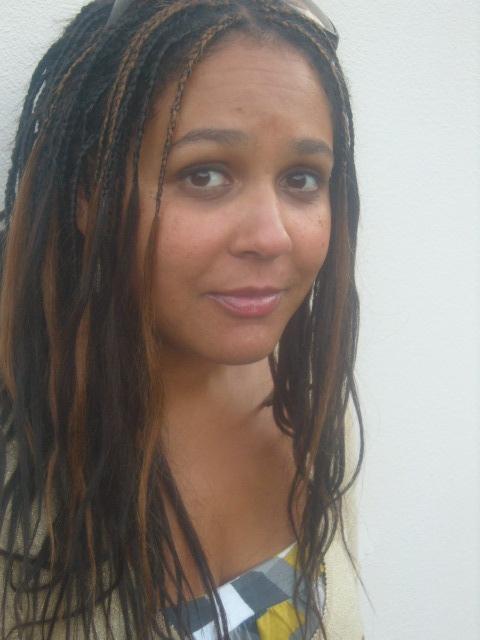
Louisa is a writer, poet and Arts Project Co-ordinator who has lived in the West Country since she was 13. Her first poetry collection, Salt-sweat and Tears was published by Cinnamon Press to critical acclaim in 2007. She has also written a book and exhibition about the history of African and Caribbean people in Dorset over the past 400 years, both entitled Dorset’s Hidden Histories. Louisa has recently worked on a project using images and stories to celebrate multi-ethnic Dorset. Funded by Arts Council England and Dorset County Council, the exhibition and book is called All Different, All Dorset was launched in September 2011. Louisa is passionate about equality and the Arts, and hopes to inspire people from a range of backgrounds to become interested in writing.
Let’s start with your writing journey
I wrote a few adventure stories when I was about six, which my mum said were like Enid Blyton books and I still have a poem written at that time. When I was a teenager I kept a diary for three years and wrote about everything that happened to me. As an adult, I turned to letter writing to try to sort out problems with relationships. In 2002, I went to Exeter University to complete the degree I’d started with the Open University, and I began writing poetry alongside the essays and coursework. I was encouraged by Selima Hill and I had a poem published in a magazine. Getting published was exciting and encouraged me to write more. I realised I had a lot to say about being dual heritage and growing up in white communities. My Dad is Ghanaian and came to England in the late 60s for education and he met and married my mum and had three children with her. We lived in Yorkshire, Cambridgeshire, and then when my Dad left we moved to Devon. Growing up knowing only the white side of my family was weird. No one wanted to talk about my background. Writing helped me to explore unresolved issues around my identity. It helped me come to terms with some of the things that had happened, racism and domestic violence.
What inspires you to write now?
Lots of different things, but I usually write about emotional and difficult subject matter, like relationships and parenting. When I’m writing poetry ideas come to me. For example, I read a newspaper article about a young girl who left her dead baby in a railway station bin and I wrote a poem about it that was shortlisted for the Bridport Prize in 2010.
How does writing prose compare to writing poetry?
I research and write non-fiction books relating to Black History but I always look for the story in whatever I write. I’ve started my first novel which came from a seed of an idea but I find novel writing more challenging than poetry because of the length and the need to navigate the story in my head. Activating the imagination in a novel is a different process to describing an event through poetry. Poetry leaps into my mind through an idea or image, but the novel takes more working at.
What do you think about writing competitions?
I entered the Cinnamon Press Poetry Competition in 2005 and was long listed. The following year I entered again and had my collection of poetry Salt-sweat and Tears published as the prize. Now, I enter competitions occasionally, but it’s usually dependent on having the time and energy to submit and the money to pay the submission fee. It’s unfortunate that the cost of entry excludes some people. I entered the Mslexia First Novel Competition in 2011 and was longlisted for my novel, The Red Behind Her Eyes. The story is about a teenager who hits back against her stepfather who inflicts violence on the family.
I think it’s worth entering competitions but don’t get too hung up about it. It’s easy to imagine you’ve got a good chance of winning and being discovered, only to be disappointed. I’d encourage people to enter, because it’s good to take part, but have realistic expectations.
Which authors and poets have most influenced you?
With poetry I was influenced in the early days by Selima Hill. With novels, I’ve read thousands and can’t remember offhand the many writers I love! At the moment I’m working my way through Emma Donoghue’s books. I like crime novels such as those by Ruth Rendell which, although aren’t great works of literature, tell a good story. I am often drawn to the darker side of life through fiction. I like writing that’s authentic, that doesn’t have to use big words to say what needs to be said. Literature doesn’t need big words – I think this excludes some readers. I do relate to black/dual heritage writers as I can understand their experiences. I love Jackie Kay’s work, fiction and poetry. Other poets I admire include John Siddique, Moniza Alvi, Linton Kwesi Johnson, Helen Dunmore, Catherine Smith, Julia Copus and many many more. I am quite fussy about both poetry and prose, and it has to somehow grab me, draw me in and really say something to me or I can’t be bothered to read it.
What tips do you have for new writers?
Keep writing, even if you think it’s rubbish. Share your work with other writers, in person or on-line. Sometimes I get family members to read my work but it’s better to get people who write to comment on your work. Read widely – you’ll get inspired by different writing styles and stories. If you read, you’ll find out what’s being published, what’s topical and how your writing compares. Keep writing because the process is important – you’ll develop skills by practising.
Thank you, Louisa