This week I began the second in a series of activities offering support to parents of young children attending Early Childhood Care and Education (ECCE) centres on the settlement. The purpose is to strengthen the psychosocial wellbeing of children by encouraging greater parental involvement. The flight to safety from conflict in South Sudan has created a legacy of loss among families on the settlement. Loss of extended family connections – some have family members remaining in South Sudan, other families are dispersed across different refugee settlements in Uganda. Loss of home and land – some families have heard their houses are now occupied by others; there has also been much destruction of property and land during the conflict. Loss of a hoped-for future – parents who wanted to continue their education or further their careers now find themselves without educational or work opportunities. These losses can impact on the psychosocial wellbeing of parents who may find themselves increasingly unable to parent effectively given the instability of life as a refugee and the effects of poverty. (Although recently there have been encouraging signs of peace in South Sudan following six years of civil war, refugees on the settlement have a ‘let’s wait and see’ attitude.) In terms of the psychosocial wellbeing of children, there is some research to suggest an intergenerational effect. Even children born in safety may share some of the wellbeing needs experienced by their parents.
As the ECCE centres are at an early stage of development, there are currently no referral systems in place to target specific support. (I am working on a database to address this by collecting information about children using the Washington Group of Questions.) For the time being, I extend an open invitation to my activities for all parents where ECCE centres are located in zone 3 of the settlement. Uptake varies according to the village but one session had over one hundred participants. In order to manage this number, I encourage skill sharing amongst parents so that those who engage with the tasks readily can support others.
‘Why play?’ is the title of the session and it considered the importance of parents taking time to play with their children. We discussed how play builds family bonds, opens lines of communication and trust which help to keep children safe, supports learning in the ECCE centre and is fun for the whole family.
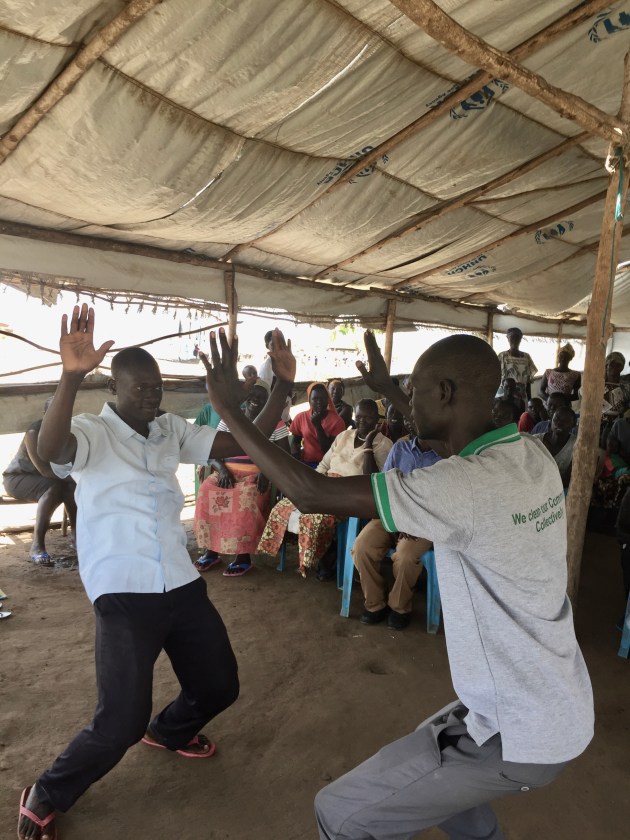
As there are few resources on the settlement or money to purchase them, we focused on games that can be played without materials or using locally available materials. We made rhythms by participating in sound exercises using clapping and clicking games. Parents then worked in partners to do a mirroring activity (one was the leader, the other the mirror so the actions of the leader had to be copied simultaneously to imitate a reflection).


 the writer is a lonely hunter