Book bloggers do an amazing job of spreading the love for books and reading. Books by your Bedside is a fine example where Victoria shares perceptive and thought-provoking reviews. She’s written an outstanding post for ‘The Secret Life Of Carolyn Russell’ for which I’m very grateful. Why not hop over and take a look at Victoria’s reviews? You might find a little known title that you’ll love nestling there.
Published By: Bloodhound Books Pages: 310 Released On: 03/07/2023
A true-crime podcaster investigates a decades-old suspected abduction, in this powerful psychological suspense novel.
1979:Sixteen-year-old Carolyn Russell grows increasingly infatuated with her school mathematics teacher who is also giving her private lessons. Then she disappears.
2014: Struggling journalist Stephanie Brett creates a true-crime podcast focused on the disappearance of Carolyn Russell. By digging deep into this mysterious cold case, her confidence and flagging career are boosted. But after she confronts the suspects—and talks to a potential witness—the leads dry up. However, Stephanie refuses to let the story rest . . . Can a small-time journalist with a shoestring podcast really hope to reconstruct the ultimate fate of Carolyn Russell after all these years, or are some secrets best left buried?
*****
Thanks to Gail for gifting me an advanced copy of her new book in return for an honest review.
for the release of The Secret Life of Carolyn Russell
At two o’clock this afternoon Bloodhound Books officially revealed the cover of my new novel The Secret Life of Carolyn Russell. Doesn’t it look splendid? The pumps and tote bag give a distinctly 1970s vibe to the mystery while the rest of the branding suits the psychological suspense elements. To be honest, it’s a relief to have this off my desk and going out into the world in less than 4 weeks. The final stages of bringing a novel to publication is a mixture of joy and panic. Release day is Monday 3 July but if you’d like to get your UK copy organised early, here’s a Kindle pre-order link. (The paperback version should be available shortly.) My thanks go to Suzanne Goldring, Joanna Barnard and Jacquelyn Mitchard for the endorsements.
An enthusiastic early reader has posted a five-star review on Goodreads. It’s a real shot in the arm when someone who’s read my previous books says The Secret Life of Carolyn Russell is her favourite to date.
Maria and I are both published by the leading independent fiction publisher Bloodhound Books. On signing my contract, I was encouraged to interact with other Bloodhound Books authors through a private Facebook group. This was where Maria and I met and we’ve taken this connection to a new level through this interview. I’m sure you’ll find Maria’s writing journey inspiring and her debut novel a sinister yet fascinating story. Here’s the blurb for The Devil’s Own.
A set of century-old diaries found in an attic draws an Irish couple into a tale of murder and madness, in this absorbing new suspense.
After forty years in the Irish army, Brian is looking forward to retiring and spending time with his wife—though he worries about adjusting to civilian life. While clearing the attic before they move house, he makes a discovery: three journals dating back to the early twentieth century.
One was written by Arthur, an ex-Connaught Ranger; another by Arthur’s wife, Edith, a colonel’s daughter; and the third by Henry, a British soldier and Arthur’s best friend.
Brian and his wife are soon engrossed in reading the diaries and following the intertwined stories of these three people from the past. But it soon becomes chillingly clear that these diaries contain more than the daily adventures of ordinary lives. Because one of the three is a killer . . .
Thank you, Maria, for joining me on The Writer is a Lonely Hunter and agreeing to answer the questions that struck me while reading your impressive debut novel.
What steps brought you to write The Devil’s Own?
The gem of the idea for this book has been lying dormant in the back of my mind since I first saw the Curragh Camp, way back in 1978. I was working, waitressing with my mother at a dinner dance in one of the messes. My career as a waitress was very short-lived! During a break over a cup of tea, we got talking to the army chef about the building we were in, the history of the camp and the general consensus on the night – if only walls could talk.
Little did I know I would end up living in the camp, albeit for a short time around 1993. The Curragh is filled with history, going back to the days of British rule. My husband was born in the Curragh, grew up there. At one stage it had a vibrant community, completely self-contained. I was fascinated by the stories I heard from his family and our friends about the people who lived in the camp. I didn’t write them down at the time. It would take another forty years for that first spark of an idea to come to fruition.
In December 2022, Chris Dawson, a former PE teacher and rugby league star was sentenced to 24 years in prison by the New South Wales Supreme Court in Australia for the murder of his wife decades earlier. Although Lynette’s body has never been found, The Teacher’s Pet podcast shone a light on Chris Dawson’s sordid affair with a pupil from the school where he worked, the obsession with her that followed, and the disappearance of his wife. Release of the podcast hosted by Hedley Thomas in 2018 finally persuaded police to reinvestigate the case and charges were brought.
I became hooked on true crime podcasts in early 2020. At the time, I was living in a remote town in the north west of Uganda and volunteering at a nearby refugee settlement. The power supply was very unreliable and cuts happened most evenings at eight o’clock. With no light to read by, I was often in bed and under my mosquito net around the same time. The nights were long and hot so I spent many hours listening to the podcasts I’d downloaded at a local hotel. I developed a fascination for crime stories from around the world but it was the series podcasts that allowed me to tune into the twists and turns that created crucial listening. It occurred to me I could learn something from the way podcasts were put together that could inform the plotting of my own fictional writing.
Prior to leaving for Uganda, I had established a regular writing routine which meant getting up early to focus on a writing project before the working day started. I hoped to continue this routine while living overseas but the demands of volunteering on the settlement and the inconsistent electricity supply put an end to that ambition. Power in the town kicked in for about 40 minutes at seven in the morning, and at that time there was always a rush to prepare for the day ahead where I worked with colleagues to improve the social and emotional wellbeing of refugee families fleeing conflict in South Sudan. It was challenging and rewarding work which left little headspace for creativity. Instead, I became absorbed in the refugee stories I collected as part of my work, and the podcasts I listened to each evening. With a wealth of material stored away, I was empowered to write again following repatriation to my home in Dorset, UK due to Covid-19.
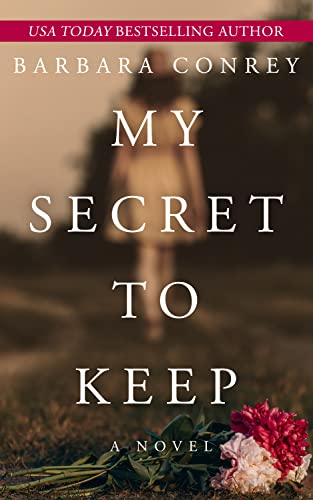
It is my pleasure to welcome Barbara Conrey to The Writer is a Lonely Hunter once again. We first met online in 2021 when she was kind enough to answer questions about her debut novel Nowhere Near Goodbye. (You can find the piece here.) She now has a splendid second novel released with the evocative title My Secret to Keep. This fascinating story made me wonder about Barbara’s writing process which she explains in this author interview. But first, here is some information about the novel:
When Maggie Bryan works up the nerve to tell her parents she’s pregnant, they immediately disown her. Later that night, her boyfriend is killed. In desperation, she turns to her brother, Sam. Against his wife’s wishes, Sam brings Maggie to his home in rural Pennsylvania.
While Maggie awaits the birth of her child and navigates the tension in her new home, she decides to finish high school. There, she meets Anne Phillips, a volunteer educator and full-time architect. Over time, Maggie becomes drawn to Anne in ways she doesn’t understand, but she knows enough to keep her feelings hidden.
After a devastating loss, Maggie tries to move on, but secrets and betrayals keep her from living her fullest life. Beginning in the late 1940s and spanning decades, My Secret to Keep portrays a woman at war with society, her family, and herself.
And now to the questions:
How much planning was involved in writing a novel that spans decades?
Writing a novel that spans decades is eerily similar to those blasted reading math problems when I was in grade school – and I wasn’t very good at them then, either. So there’s a lot of counting forwards and backward and practically using my fingers to ensure I’ve got my timelines right.
The blurb describes Maggie as a woman at war with society, her family, and herself. This so clearly describes the protagonist, and yet she achieves acceptance too. Did you know what would happen at the end of the novel when you started writing the book?
The ending of this book nearly did me in because Maggie only achieved acceptance, and by this, I mean accepting herself after she lost Anne. I was devastated.
You cleverly dovetailed the latter part of the novel with the story in your debut, Nowhere Near Goodbye. This gave me the chance to reconnect with Kate’s story. Was this your intention?
Most people don’t know that once Nowhere Near Goodbye was under contract, I had to rewrite a good half of the book. I had originally submitted it as a two-person point of view, with one being Emma and the other being Kate. My editor convinced me I could make a stronger story by changing to a single point of view, Emma’s.
So I had all this material. Some of it I used in Maggie’s character in Nowhere Near Goodbye; don’t forget, I had to rewrite a good part of the book, so I fleshed out Maggie’s role, and when I did that, Maggie became much more interesting. That’s when I started thinking about a prequel to Nowhere Near Goodbye to tell Maggie’s story.
The copyedits for The Secret Life of Carolyn Russell were returned to me recently. I had a fortnight to go through them and found this was just about long enough to complete the changes needed. Here are three things I was reminded about along the way:
Compound words
How could I have got so many compound words wrong? Take two separate words and combine them to make a new word with a different meaning. When you put the nouns post + box together, created is the red box where we post our letters, a postbox. Sounds simple, right?
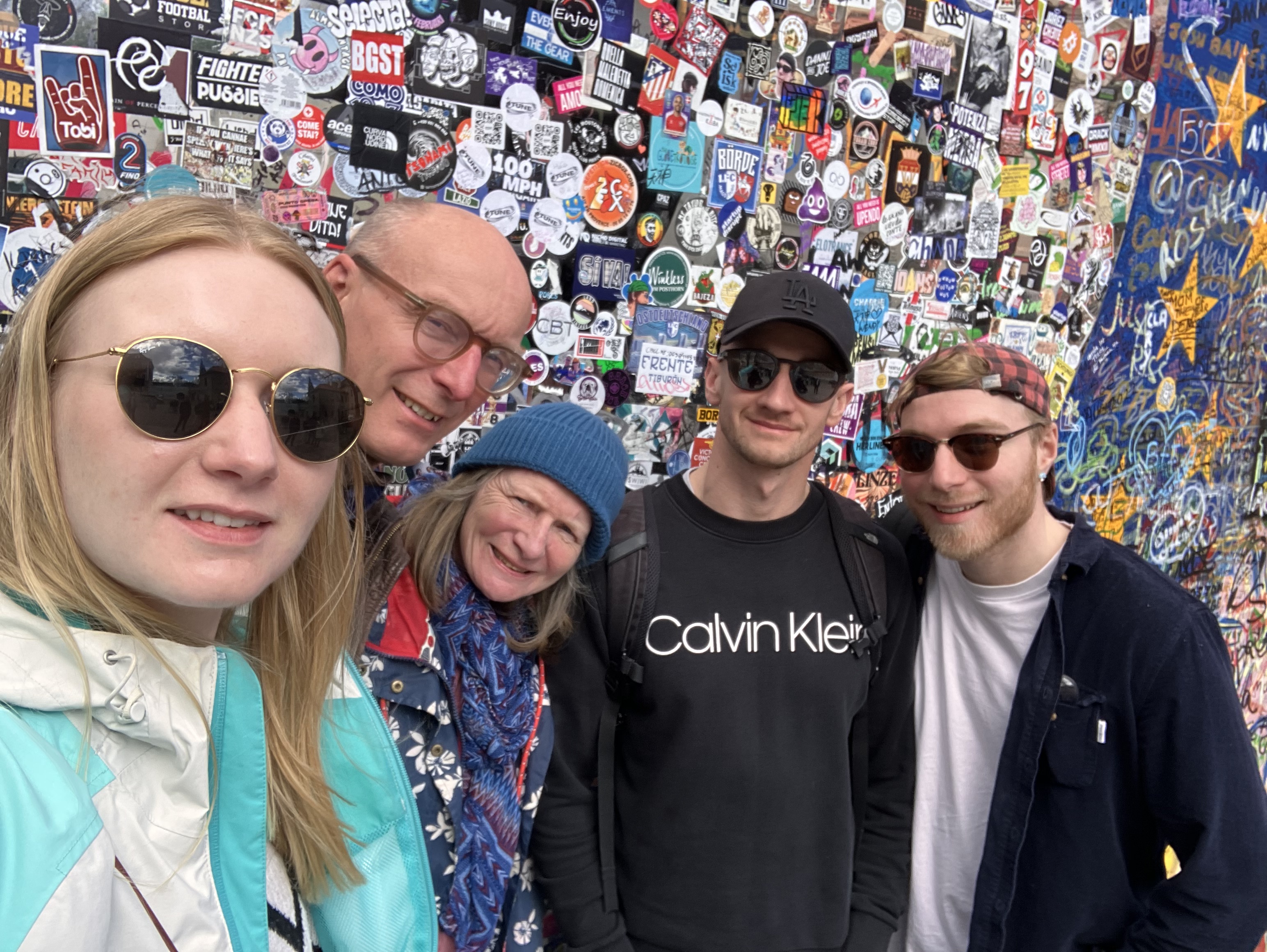
I was pleased to spend a few days in Prague with my family at the end of March. The trip was originally planned for 2020 but postponed due to Covid. We stayed in a central location and wandered the cobbled streets until my feet cried for mercy. It was good travelling as a group because we each had different things we wanted to see. All set for a bit of endurance sightseeing, we tackled the Prague castle complex on the first day. Other highlights included watching the astronomical clock strike the hour, the view over Prague from the Petřín lookout tower, the Jewish quarter and photos in front of the Lennon wall.
It was International Women’s Day on Wednesday 8 March 2023, a global event which celebratesthe social, economic, cultural and political achievements of women. As my contribution to the day, I joined a group of readers and writers at Bridport Library where there was a series of events including a writerly quiz, a lucky dip and talks by local writers. I was delighted to be interviewed by Sarah Scally who asked some searching questions about This Much Huxley Knows. Also on the programme was Nikki May who enjoyed phenomenal and rapid success with her novel Wahala, which tells the story of three Anglo-Nigerian best friends and a fourth woman who infiltrates their group. (I have the novel on order from Dorset Libraries and will watch out for the TV series coming on the BBC.) It was refreshing to hear about her writing journey where it took five years to become an overnight success.
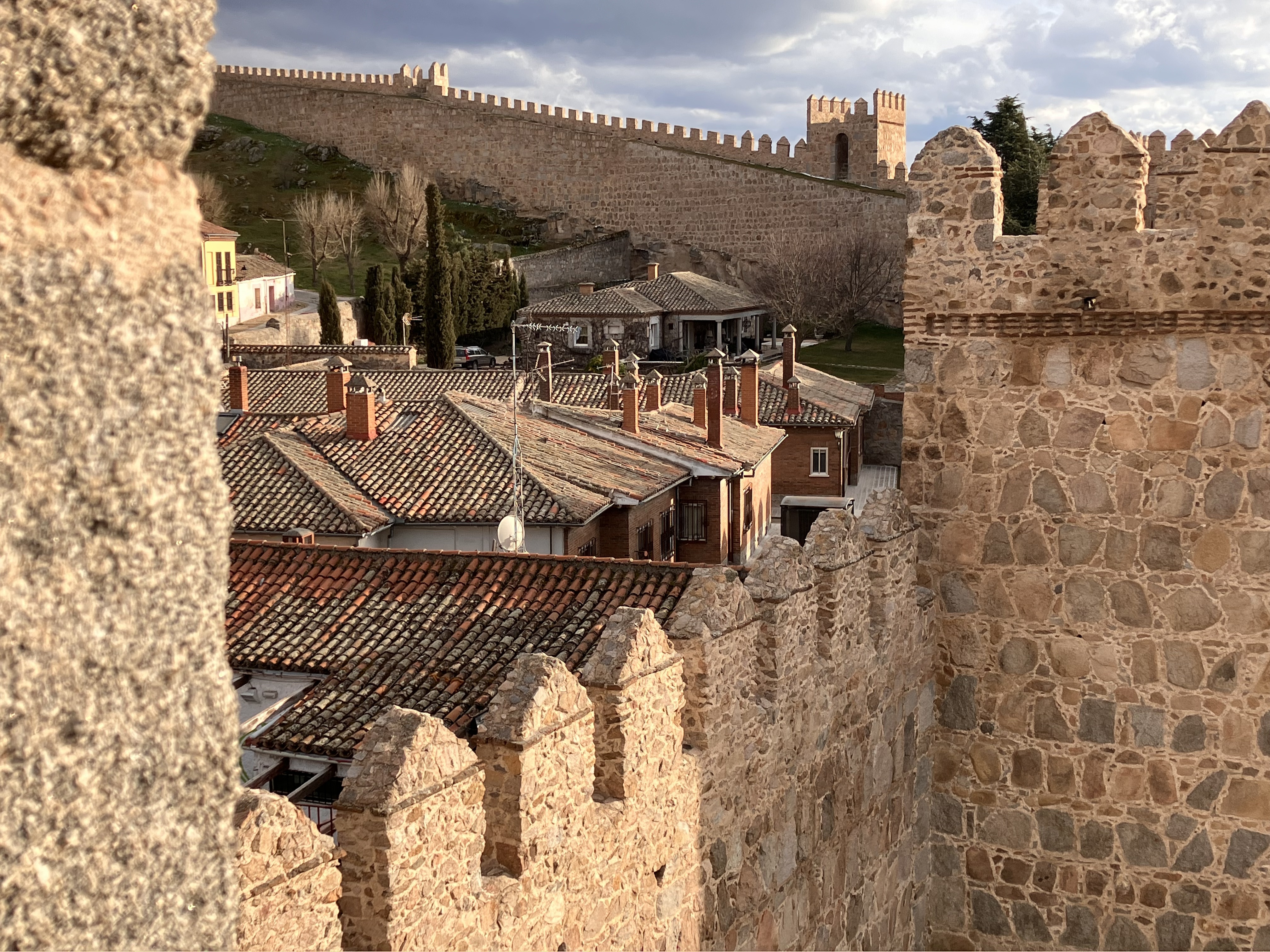
It has long been an ambition to visit Ávila, close to Madrid in Spain. I love walled cities such as York and Ávila is equally impressive. ( I love to see the housing inside the walls.) When I realised it was possible to volunteer with Vaughan Town at el Barco de Ávila (a town not too far from Ávila), this killed two birds with one stone.
Vaughan Town is an organisation which recruits native English speaking volunteers to improve the spoken language skills of Spanish business people. Participants experience English emersion with over eighty hours of contact. As volunteers, David and I got to stay in a four-star hotel for six nights with all meals provided (three courses with wine at lunch and dinner plus a sumptuous breakfast). Volunteers came from Canada, England, the USA and Ireland. It was a unique opportunity to meet interesting people and converse with members of this intergenerational group. As well as one-to-ones, there were scripted telephone calls, group activities, presentations and comedy sketches. It was a rewarding experience to be part of the journey that saw participants develop their skills and fluency in using spoken English. I thoroughly recommend volunteering.
I’m here as the narrator in Cinderella (if you can see behind David’s head).
Now I’m back at home again, there’s lots of catching up to do. I’m continuing to work on a new novel set on a tropical island which focuses on the tension between affluent holidaymakers and local communities. The Vaughan Town experience has given me ideas for another story, so you could call it research.
But, the new priority for this week is getting in a practice run in preparation for the Weymouth half marathon on 19 March. Wish me luck!
I volunteer with the Women Writers Network and help to bring attention to women writers by managing the Twitter account for one week every couple of months. (It’s worth following the Twitter account where a writerly tweetchat is held on the third Thursday of each month at 6pm GMT. The next topic is Women Writers as Observers on 16 February 2023.) In order to engage with readers and writers, I frequently pose questions to develop connections and on one occasion came up with the following: how important is self-belief to writers? It was clear from the tweets that came back, many women writers think self-belief is highly important or even crucial to a writer. How else do writers develop the stamina and commitment to bring a project to its conclusion? The suggestion took me by surprise. Belief in the work had always been at the top of my list – the feeling that my stories are important and I’m the only one who came write them. But, I was forced to reflect. If self-belief is necessary for a writer, how do I get some?








 the writer is a lonely hunter