the writer is a lonely hunter

writing by Gail Aldwin and other authors

Bidibidi Refugee Settlement: activities to support psychosocial wellbeing

This week I began the second in a series of activities offering support to parents of young children attending Early Childhood Care and Education (ECCE) centres on the settlement. The purpose is to strengthen the psychosocial wellbeing of children by encouraging greater parental involvement. The flight to safety from conflict in South Sudan has created a legacy of loss among families on the settlement. Loss of extended family connections – some have family members remaining in South Sudan, other families are dispersed across different refugee settlements in Uganda. Loss of home and land – some families have heard their houses are now occupied by others; there has also been much destruction of property and land during the conflict. Loss of a hoped-for future – parents who wanted to continue their education or further their careers now find themselves without educational or work opportunities. These losses can impact on the psychosocial wellbeing of parents who may find themselves increasingly unable to parent effectively given the instability of life as a refugee and the effects of poverty. (Although recently there have been encouraging signs of peace in South Sudan following  six years of civil war, refugees on the settlement have a ‘let’s wait and see’ attitude.) In terms of the psychosocial wellbeing of children, there is some research to suggest an intergenerational effect. Even children born in safety may share some of the wellbeing needs experienced by their parents.

As the ECCE centres are at an early stage of development, there are currently no referral systems in place to target specific support. (I am working on a database to address this by collecting information about children using the Washington Group of Questions.) For the time being, I extend an open invitation to my activities for all parents where ECCE centres are located in zone 3 of the settlement. Uptake varies according to the village but one session had over one hundred participants. In order to manage this number, I encourage skill sharing amongst parents so that those who engage with the tasks readily can support others.

‘Why play?’ is the title of the session and it considered the importance of parents taking time to play with their children. We discussed how play builds family bonds, opens lines of communication and trust which help to keep children safe, supports learning in the ECCE centre and is fun for the whole family.

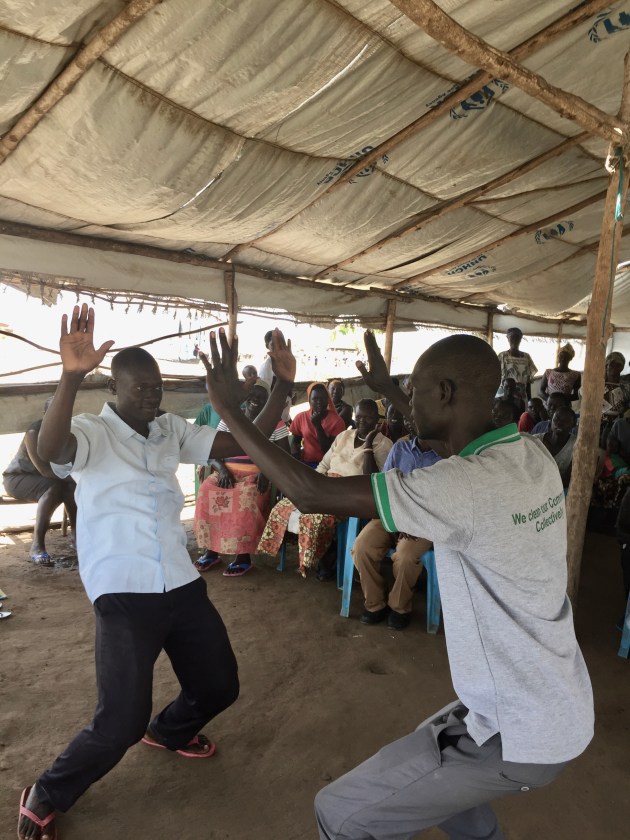
As there are few resources on the settlement or money to purchase them, we focused on games that can be played without materials or using locally available materials. We made rhythms by participating in sound exercises using clapping and clicking games. Parents then worked in partners to do a mirroring activity (one was the leader, the other the mirror so the actions of the leader had to be copied simultaneously to imitate a reflection).

C517DB3B-D2DD-4D97-94FB-714EF77CB2A8_1_201_a

Read the rest of this entry »

6 Comments »

Coming and going, ups and downs

I arrived back in Yumbe on Wednesday evening after an eventful few days in Kampala. The immigration office refused to extend my tourist visa as my work visa was being processed. Although I didn’t have all the required original documents with me, colleagues at VSO sent me back to the office to claim my work visa. As VSO is a charity and doesn’t pay from work visas, there was a delay in the issuing process. However, I was the first of all the VSO international volunteers in Uganda to have the  work permit stamped into my passport. I believe others are now following a well trodden path to the immigration office to get their work visas after my success.

The next important job involved updating the registration of my Ugandan SIM card. Mobile phones are absolutely essential in Uganda (and other countries in Africa) because this enables access the internet, WhatsApp for messaging, video and phone calls, social media and most importantly MONEY. I have a mobile money account where VSO deposits my monthly allowance and money to fund the activities I run on the settlement. It is an incredible system whereby it’s possible to withdraw money from kiosks located in even the most remote locations. You can also send money to other people, pay utility bills  and OTT. This is a tax levied on the use of social media and can be paid daily, weekly or monthly depending on frequency of use. I’ve taken to carrying my mobile phone around in my money belt as losing this essential piece of kit would be such a nightmare. However, I’ve since discovered that losing access to the SIM is equally horrific.

My tourist visa expired today and something must have gone wrong with the registration of my work visa as my SIM is not working. My first visit was to the MTN service office in Yumbe where they said re-registering would solve the problem. It took forty-eight hours to get this done the first time, so I’m not confident of a quick result. Now I’m using the internet connection at the hotel to try to resolve the situation. Fortunately, MTN is good at responding to direct messages on Twitter – this is a relief as I obviously can’t contact them by phone. While I’m waiting for a response, I sit in reception at the hotel (the only good place for internet access) and type this post.

The drive back from Kampala to Yumbe was long even with sealed roads most of the way. My driver took a wrong turning at the final stage and we ended up at the border with South Sudan. The photo below shows the crossing point and reinforces the idea that country borders are arbitrary – this view of South Sudan looks exactly the same was the rest of West Nile in Uganda.

IMG_4968

I arrived at my accommodation to find no water and no power. The lack of consistent supply is ongoing in Yumbe. I’m so used to the shortages that I’m now overjoyed to find water and electricity available rather than getting ratty when they’re not. Sleeping without a fan is the worst but it’s amazing how it’s possible to get used to things. I now drip sweat all night as well as all day!

Read the rest of this entry »

7 Comments »

Would you believe it?

I am in Kampala again as a result of a ‘would you believe it?’ moment. On Friday I travelled to Gulu because I needed to extend my tourist visa to provide cover until my work permit is issued. I was told renewal was a simple process, all I had to do was turn up at the office, produce my passport and pay a fee. After a six-hour drive from Yumbe, I went straight to the immigration office. I had heard from fellow volunteers based in Gulu that it had taken them five hours to acquire the necessary renewal. I wasn’t too worried because if I failed to get the stamp issued that day, I could always go back on Monday. But oh no. The immigration officer was away at a meeting.  He also had meetings scheduled for Tuesday and Wednesday so was unlikely to report at the Gulu office until Thursday! Back in Yumbe there’s a busy week ahead scheduled including an important visit from the VSO project manager on Thursday. “Is there anywhere else I can get the visa extended?” I asked. By this time, I was starting to panic. I absolutely need to have a valid visa otherwise I could face a fine or imprisonment! ‘Go to Kampala,’ came the reply.

After another seven-hour drive I am now in the capital. It’s good to be back. I know my way around the Tank Hill Road area well and the cooler climate in Kampala means I can sleep under a blanket for a change. I even have a balcony to enjoy the view of Lake Victoria.

IMG_4958

The only (slightly) troublesome thing about Kampala is mosquitoes. I have been very impressed that my regime involving the daily application of mosquito repellent and the wearing of socks, long sleeves and trousers in the evening has worked well. Other measures include sleeping under a mosquito net (and taking anti malarials) which have kept me safe. But, there’s no protection while taking a shower and one crafty mosquito managed to get me twice on the thigh. These bites have turned into huge, red welts and even antihistamines can’t stop the itching. I’m so glad that getting bitten by a mosquito is a rare occurrence. It was one of the things I worried about before leaving home, but with a rigorous routine, there really is nothing to be fear. Would you believe it?

Read the rest of this entry »

2 Comments »

The high points and pitfalls of volunteering overseas

There is plenty to enjoy about my placement with VSO. The organisation has a thorough recruitment process, there’s excellent training before departure and throughout the onboarding period of preparing to leave the UK, I felt very well supported. On arrival in Uganda, there was a delay in arriving in at my placement, but I joined VSO team building in Mbale, had time to relax in Gulu and went on a river cruise and safari at Murchison Falls National Park.

I was appointed as a psychosocial and child protection volunteer at Bidibidi refugee settlement and joined an excellent team of experienced practitioners who support seven Early Childhood Care and Education centres in Zone 3. I love working with my colleagues and have learnt so much from them. One of the first learning points was to adjust my use of English to make it ‘easy to hear’ for host and refugee families. I copied my colleagues’ patterns of speech to make my utterances more like standard Ugandan English. The key is to speak slowly, emphasise key words and always avoid unnecessary language. For example, Ugandans say ‘you come’ rather than ‘can you come here?’ It is a language of imperatives. I enjoy this direct way of speaking and find some of the vocabulary charming. If you need a ‘short call’, you’ll be directed to the toilet or latrine. And ‘to pick’ is a high frequency verb because it means to choose, to collect, to take or to pick depending on the context: it’s the job of young girls to pick firewood on the settlement.  I also much admire the training my colleagues offer to a range of audiences. There is always humour in their delivery, time for laughter and a joy in sharing anecdotes.

My experience of delivering training to refugee and host community parents living on the settlement has been positive. Although the groups have been huge (over one hundred parents in some villages) I have been able to explain the need for parents to support the psychosocial wellbeing of their children (with the aid of interpreters). Further sessions are planned to focus on developing constructive patterns of talk with young children and the need to play with children to build family bonds.  Many of the parents on the settlement have known no other existence besides living in conflict and displacement. Their skills and confidence to parent effectively have therefore been diminished, sometimes due to the lack of good parenting they received. My input aims to break this intergenerational cycle. It is rewarding work.

The most difficult part of my placement is getting used to living in Yumbe. I don’t think I was adequately prepared for what to expect. There is very little information about Yumbe on the internet and although I asked everyone what they knew the place, I only ever got two responses: the road is very bad and it is very hot. Yumbe is a town with limited resources, poor transport links to other destinations and few social outlets. I guess this only to be expect – refugee settlements aren’t normally found in desirable locations. Other NGOs classify their projects according to the hardship of the placement. Refugee camps in Syria are classed as hardship 3 area. Yumbe falls just below this at hardship 2 category. This means that accommodation for staff and volunteers at some NGOs compensates for the hardship of the placement. Friends live in comfortable accommodation with air conditioning, a generator for a constant supply of electricity and water tanks to ensure the availability of piped water. Others (including two of my colleagues) spend Monday to Thursday in Yumbe then return to the relative luxury of Arua each weekend. This week I experienced a twenty-four hour power cut (which meant sleeping during the hot night was impossible without a fan) and photocopy resources for training sessions was problematic. There is a water shortage in Yumbe during the dry months of January and February. Although where I live has a water tank, for some reason it was not supplying water this week and I had no access to piped water from Monday to Friday. Fortunately, I was able to return to the hotel where I stayed during the initial period of my placement and used the shower facilities there. (I won’t go into details about the difficulty in living for that period with a non-flushing the toilet – too unpleasant.)

Read the rest of this entry »

3 Comments »

News about my creative writing

In all the time I’ve been busy volunteering in Uganda, there has been activity on the creative writing front at home. I was shortlisted in a poetry competition run by my publisher Victorina Press. My entry has now been translated into Spanish and included in this beautiful bilingual poetry anthology. David sent me a photo and I’m looking forward to reading the book when I get home.

87001784_10216092675456241_8977790518448619520_n

Other news relates to the The String Games. My debut novel is one of fourteen finalist in The People’s Book Prize and voting is now open to select a winner in the fiction category. Thank you to everyone who has supported me to reach this stage. You are now able to vote again and if you haven’t voted before, this is your chance. Find out all about The String Games here. You don’t need to have read the whole novel as the opening pages are available for you to make a judgement. When you’re ready to vote, scroll down, add your details, tick the box and submit. The String Games is up against some stiff competition but wouldn’t it be great to see a Dorset writer on the stage come presentation day? Congratulations to the other finalists.

mock03


1 Comment »

Visiting Arua

During the last month in West Nile region of Uganda the weather has been hot (it’s called the sweltering session for a reason). This weekend I decided to head south for some R&R. Yumbe is the town where I live, (it’s also the name of the district where Bidibidi refugee settlement is located) and Arua is the nearest town which has facilities such as a bank with an ATM, supermarkets, cafes and even a hotel with a swimming pool. These luxuries make Arua a desirable destination.

My colleague Zachary accompanied me on the bus to Arua. We had a full day of work on Friday with training for members of the Male Action Group  on gender-based violence, child protection, social accountability and inclusion. It was difficult to get away promptly so we caught a later bus than planned and every seat was taken. The journey to Koboko is on an unsealed road and the bumps made me gasp so loudly my fellow passengers laughed. After that it was a smoother journey and we reach Arua in about two hours.

On Saturday I woke to a sunny day and considerably cooler weather. I have a room at the White Castle Hotel which is a charming place. Accommodation is in bungalows around the gardens and tucked away is a tempting swimming pool. After the sunburnt, dustbowl of Yumbe, this really is a delightful change. Even the scenery around Arua is distinctly different. The town is close to the border with Democratic Republic of Congo and apparently the undulating landscape is more like DCR than the flat planes of West Nile.

IMG_4856

Taking a weekend of R&R also means some indulgences. I went to the supermarket and bought treats including crystallised ginger (it’s amazing the idiosyncratic nature of stock in remote places). I also bought a few basics including nuts and seeds. Now I’m sitting by the pool enjoying a glass of wine. The first dry white I’ve had in months.

I was ferried around Arua not by a boda-boda (motorbike) but by a tuk tuk.  (I actually hate riding a boda without a helmet and this would have been much too cumbersome to carry on the bus.) Only smaller towns in Uganda licence tuk tuks as in a city like Kampala these additional vehicles could become a hazard. But in Arua they are a fine way to get about.

Sending greetings from a relaxed VSO volunteer to all my followers.

Update:

I wrote this post yesterday and just needed to insert the photos. Before I managed this, I came down with a vomiting bug and I’ve been laid up ever since. It’s now Sunday evening and fortunately I’m feeling better. But the training planned for Monday will have to be postponed as I need to move around slowly and will take the bus back to Yumbe tomorrow afternoon. Not such a great R&R after all.


5 Comments »

A week at Bidibidi

Now that I’m feeling more confident in my role as a VSO volunteer with Early Childhood Care and Education (ECCE) at Bidibidi refugee settlement, Uganda, it’s about time I introduced the team. My colleagues include two exceptional practitioners who have substantial experience in teacher education. They are national volunteers, Zachary Alio and Josephine Lubwama. Both have come out of retirement and have given up the comfort of their family homes to support the children of refugees from South Sudan and national families living in the far north west of Uganda. We work under the guidance of our team leader, Christine Abala who offers brilliant direction and support. Christine has a background in social work so she is very well placed to advise on the needs of vulnerable children.

187B6039-3AF0-4476-96E5-F49056CD4C4F_1_201_a

Josephine, Christine and Zachary

I am so impressed with the work my colleagues are doing in training, mentoring and supporting refugees and and local Ugandans to act as caregivers to young children attending ECCE centres. The caregivers are fluent in English and the local language of Lugbara or Bari which is the name for a group of South Sudanese dialects. The caregivers are educated to the standard required for students entering teacher training, but few have formal teaching qualifications. Therefore, the support offered by Josephine and Zachary is essential to ensure the safety, learning, play and wellbeing of children from 3–6 years enrolled at the seven centres in Zone 3, Bidibidi. You can read more about the settlement here.

IMG_4774

Josephine training the caregivers

The caregivers attended refresher training delivered by Josephine this week. The session  involved planning of learning according to the National Early Childhood Development Framework. I loved the way Josephine offered training – it was full of empathy, passion and humour. Such a shame I couldn’t stay for the whole day, but I had learning to deliver as well.

My role at Bidibidi relates to psychosocial wellbeing. UNHCR uses the term mental health and psychosocial support to describe “any type of local or outside support that aims to protect or promote psychosocial wellbeing or prevent or treat mental disorders.” As I am working with young children, I started my programme of activities by delivering an introduction to the psychosocial support parents can offer their children in the home. This involved a two-hour session at each of the seven centres. I was ferried around the settlement by motorbike on some days, by a four-wheel drive vehicle on others. It was great fun working with the parents and the turn out at some villages was over one hundred and twenty people. (I shall never again have anxiety about addressing large groups!)

IMG_4787

Temporary roof repairs meant everyone could sit in the shade.

Delivery of the training I had planned was challenging because everything I said needed to be interpreted by volunteers into the local language and Bari. I had to do a lot of thinking on my feet when the interpreter’s grasp of English was more limited than I had expected. Although the flip chart displays I had prepared included illustrations, the language was too advanced, so I had to adjust my talk to avoid use of technical language, complex sentence constructions and colloquialisms. The other problem with using flip chart paper was the wind. Most of the venues were church buildings with thatched roofs and half walls. I had to chase after one of my sheets when I gust took it! Everyone laughed, thank goodness.

Read the rest of this entry »

5 Comments »

Meandering and thinking: a post about Idi Amin, chapatis and red dust

AD050D18-BDAE-4964-9F02-8506F8266A70_1_201_a

Christine, ECCE project leader, reads my office display about systems to support violence free lives

I walk to the VSO office in Yumbe each morning. Often it’s an early start because it takes an hour to drive to the distant villages in zone 3 Bidibidi, where the Early Childhood Care and Education Centres are located. It feels like I’m a minor celebrity as people call out ‘Sister, good morning!’ and I return the greeting. During the last couple of days there’s been rain in Yumbe, which is unusual for this time of year. December, January and February are known as the sweltering season with rain arriving in March. I’m told February is the hottest month and temperatures reach up to 40 degrees. When it’s hot and dry, the red dust is a real nuisance. It stings my eyes and gets between my toes, even when I’m wearing trainers. I’m very glad of the eye drops and athlete’s foot cream I brought with me.

It gets light in Yumbe around 7am and and that’s when I take the opportunity to have a run around the town. Usually goats are the only obstacles but on this occasion they sheltered under a porch.

A7079F39-42C8-42DF-8EFF-DB5F40B1DF41

Goats are seen as a wise investment for refugee families living on the settlement. If they are able to earn some shillings, for example, from making bricks out of soil and water for house building, the money raised can be put towards buying a goat. The animal is then fattened and kept until a big expense arises. School uniform, the voluntary fee imposed by school PTAs and supplies of school equipment are a major concern where families have several children.

In restaurants all over Uganda, goat meat is on the menu. We ate it at the VSO team building barbecue in Mbale back in December, and I’ve seen goat curry on offer in several hotels I’ve stayed in. It’s interesting that the food of the Asian minority (who where expelled from Uganda in 1972 by Idi Amin) remains popular. Vegetable and beef samosas are available everywhere and chapatis are cooked but served differently to Indian ones. In Uganda, chapatis are rolled into a cone with the outer layers brushed with oil.

Asians, mainly from Gujarat, settled in Uganda during the time of the British administration. By the 1970s many ran businesses or farms. When Idi Amin issued the notice of expulsion they had only ninety days to leave the country. Asians were forced to abandon their properties, cars and possessions. Businesses were reallocated often to people who had no experience and these subsequently failed. When President Museveni came to power, he invited Gujaratis to return to Uganda and many took up the offer.

Idi Amin was from West Nile, the region where I’m currently based. To reach Yumbe, you drive through the town of Koboko, the place of Idi Amin’s birth. This is also where the sealed road ends and the journey across red dust begins. Oh dear – it seems we’re back to red dust again. Even the forecourt of the petrol station in Yumbe is made of the stuff. And this is one of the final landmarks on my walk to work.

B14484CF-0273-4AAB-8856-D93E39721D48


1 Comment »

Back to school in Bidibidi

As the new school term in Uganda starts on 3 February, this week I joined a back to school campaign with partner organisations working in Bidibidi. There is a really strong educational collaboration amongst NGOs working at the refugee settlement and I was pleased to represent VSO alongside UNHCR, Office of the Prime Minister – Government of Uganda, Save the Children, Norwegian Refugee Council, World Vision and Humanitarian Inclusion. The partnership lead is Finn Church Aid.

I delivered input at a meeting in village 7, zone 5. Parents and children joined a call and response which I used to demonstrate how simple songs and rhymes support the psychosocial wellbeing of children. Where children have experienced the flight to safety, educational settings and schools are very well placed to normalise lives. Even children born in refugee settlements may suffer from the intergenerational effects of trauma suffered by their parents. It is therefore very important to offer high quality early learning experiences for children to build their learning, skills, confidence and resilience. As not all children from three to five years of age are accessing early learning, the meeting was a great opportunity to share the benefits and encourage parents to enrol their young children.

At the meeting parents were encouraged to offer feedback on the educational provision their children receive. Schools on the settlement do not charge fees (unlike elsewhere in Uganda) so access to free education is much appreciated. Some learning resources are also offered.  Concerns are very similar to situations in schools across the world. For example, the issue of overcrowded classroom was raised. In UK schools a large class might comprise more than 30 pupils, the average primary class in Uganda has 53 pupils but in classes on the settlement there are sometimes 150 children trying to learn. (Children who arrive at school early get to sit in the classroom while others peer in from the windows.) The other contentious issue is school uniform. Parents want school uniform for their children but can’t afford to buy it.

AB5C2698-9AB4-443D-A046-4427A094BA94

Later in the afternoon, I joined another session at Okuban village. There was a huge group of parents and children who contributed to the discussion. I came away much more knowledgable about the educational experiences of refugee children and the provision put in place by NGOs on the settlement.


2 Comments »

Bidibidi Refugee Settlement

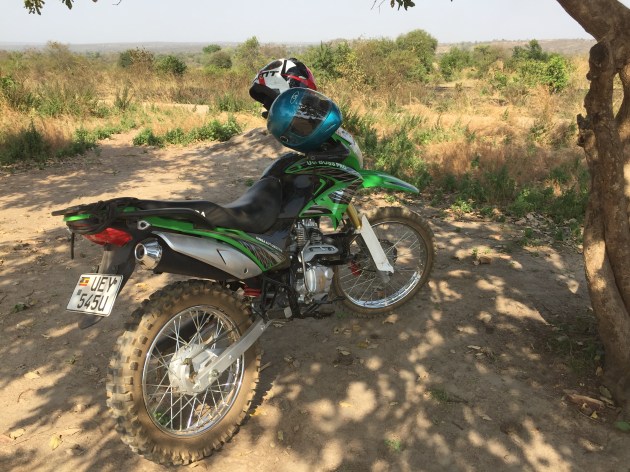
It’s been a long time coming, but I finally made it to Bidibidi refugee settlement earlier this week. I was a pillion passenger on this off-road motorbike.

6E141557-4AD5-413E-84FB-E3E6DBFCC12B

Mine is the black, white and red helmet and I was very glad to wear it. The road from Yumbe is unsealed and the red dirt is so rutted that in places it felt as if we were driving over corrugated iron. I was surprised I didn’t crack any of my teeth from the juddering! Other times, we skirted around massive holes and rode up and down hills. My arms ached from holding tightly to the passenger handgrips and my thighs aren’t used to being stretched over a seat for what turned out to be an hour long journey to Zone 3. There are other hazards on the road, too. Whenever overtaken by a car or truck, dust swirls  into a plume of red and visibility is significantly reduced. I didn’t realise cattle were such a liability – they always have right of way.

We arrived at village 16, where a temporary structure has been erected for the VSO Early Childhood Care and Education (ECCE) centre that caters for children from three to six years. It only requires flooring to be ready for the new school year which starts at the beginning of February.

This morning I was working with my colleague Zachary to prepare training materials that will enable parents and caregivers to create displays and learning resources for the centre.

IMG_4641

The village was almost completely deserted but for this woman cooking beans on a fire. She laughed when I asked to take her photograph, but I loved her colourful clothes.

It turned out that most of the residents were at a workshop offered by an NGO at a nearby primary school. The organisation was promoting the use of briquettes to prevent conflict over firewood which is an ongoing issue at the settlement. Refugee women feel vulnerable while collecting firewood and accuse men of the host community of  gender-based violence. The Aringa men claim they have been misunderstood as there is no shared language between the refugees and the host community.  But they also need firewood to make charcoal and refugees collect it for cooking purposes. Firewood is a resource that is becoming more scare due to the 230,000 refugees that now live amongst the host community in the 250 square kilometre area that until the arrival of refugees was regarded as ‘hunting ground’. However, since 2016 when refugees first came, each family are given a plot of land with the expectation they will build a house and grow vegetables. The land around the villages in Zone 3 has such rocky soil it would seem impossible to grow anything and therefore refugees are dependent on food aid.

IMG_4632

We next went to village 15, where with the help of a megaphone, one of the community leaders alerted parents and children to our presence. The group comprised many children with disabilities, from hearing and sight loss, to speech and mobility issues. My colleagues are so concerned about the number of children with disabilities who are not receiving education or healthcare, we have developed a new enrolment form for 2020, which includes the Washington Group of Questions. By posing these questions to parents, it is hoped we can develop a database to share with health professionals so that children can receive the aids they need to enable access to education.

While I was with the parents and children, I decided to do share a story and used a rainbow string to help in the telling. String games are international and parents within the group were able to make the complicated figures that I struggle to produce.

The following day, Zachary and I visited village 11 where the temporary structure requires tarpaulin walls as well as a floor. Until the centre is ready, the four to six-year-olds meet in a church building while the three-year-olds play and learn under the shelter of a tree. The staff at the centre are keen to get back to work. I was so impressed with their team work, their ability to galvanise parental support and their commitment to the children in their care. Such a fantastic group of caregivers from both host and refugee communities, that I had to take a photo.

1D49DF06-6490-4590-B5CF-A2473517A372

I’m now approaching my first weekend in Yumbe. My colleagues are with their families in Arua and Kampala so I am alone. But I have activities to plan and writing to do, so I won’t mind too much.

3 Comments »