the writer is a lonely hunter

writing by Gail Aldwin and other authors

Posh frocks, presentations and prizes

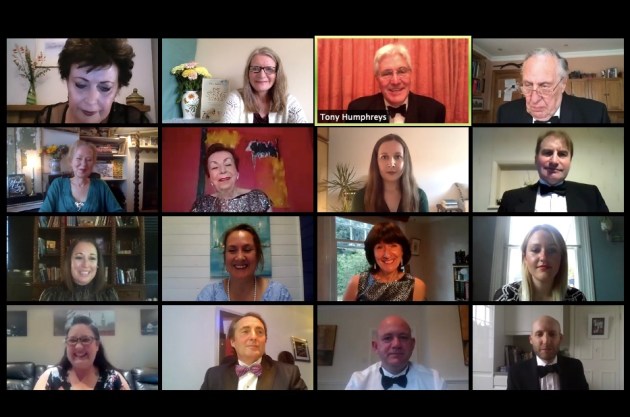
Traditionally held at Stationers’ Hall, the eleventh annual awards ceremony for The People’s Book Prize was instead organised via Zoom thanks to Covid19. Finalists from the three categories were there, authors of fiction, non-fiction and children’s literature, plus all the publishers. The evening was hosted by founder Tatiana Wilson and director Tony Humphreys. At one point I found myself virtually rubbing shoulders with prize patron, Frederick Forsyth.

EE2DAC2B-898A-4CF1-8B9C-462815B8A6F1_1_201_a

We wore our finest clothes to make the occasion special. While I drank a cup of tea, others sipped wine. Like all finalists in the fiction category, I was able to say a few words about my novel and then the winner was announced. Author of The Weighing of the Heart gained the the sparkling trophy and I was very pleased to celebrate Paul Tudor Owen‘s success. I’ve been following Paul on Twitter for some time and feel I know him from the podcasts and interviews he’s offered since his novel was launched in March 2019. The Weighing of the Heart is a contemporary novel set in New York where the English protagonist Nick Braeburn becomes fascinated by his landlady’s Egyptian art and a young artist who lives nearby. Paul was very gracious in his acceptance speech and highlighted the importance of small presses in bringing to market stories that are overlooked by the big five publishers.

CB7220AF-FF9E-4800-BC8E-7265724EA347_1_201_a

Who can you spot in this photo of fiction finalists and others?

Becoming a finalist in The People’s Book Prize has been a wonderful experience. It’s raised the profile of my coming-of-age novel The String Gamesprovided a platform for my publisher Victorina Press and has given me the chance to connect with lots of wonderful authors. And there are many of you reading this post who I have to thank for helping me reach the finals. Without your votes, I would never have come this far. So, let me take this opportunity to thank you very much for your support.

7 Comments »

Milking an idea

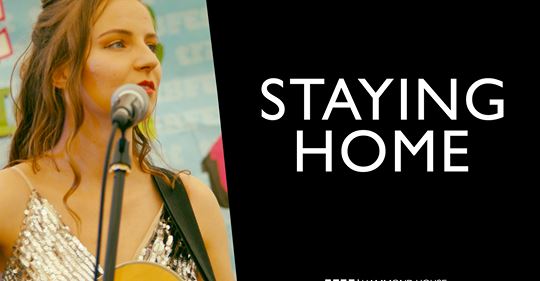
I posted information last week about Covid19 writing opportunities and since then I’ve had two Coronavirus stories accepted for publication. Out of the Box is about cutlery trapped in a canteen during lockdown and it was shortlisted in the Staying Home competition run by Hammond House Publishing. You can read the story here.

safe_image.php-4

Once I get an idea for a story, I figure it’s worth milking, so I wrote another Covid19 lockdown story this time related to the experience of a wedding ring confined to a jewellery box. This was published by Pandemic Magazine and you can read the story here. There’s a great illustration to accompany my story, so it’s worth popping over for a look.

Read the rest of this entry »

2 Comments »

Pandemic writing opportunities

Coronavirus has inspired even more people to write fiction. This is a good  thing because stuck at home or venturing out, anyone can take a leap into the world of their imagination. I have long argued that as humans we all need a creative outlet, be it gardening or cooking or painting. Writing is one of the most accessible forms of creativity because the resources required are no more than a piece of paper and a pen. And, with only the hand moving across the page, it’s not physically demanding either (although some of us do complain about writer’s bottom!)

In Dorset, our local history centre started a project in early April requesting people keep diaries of their experiences during the pandemic. The aim is to ensure that future generations can look back on the present day’s experience and understand the impact of Coronavirus across the county.  I look forward to reading the Corona Diaries when they are published.

Read the rest of this entry »

Leave a comment »

Waterloo Festival 2020

The Waterloo Festival has been running for ten years and it’s a great celebration of community and creativity. St John’s Church is behind this venture and works with partners in the area to generate a variety of creative happenings during the festival month of June. I’ve entered the annual writing competition for three years in a row and I’ve been fortunate to be amongst the winners each time. In previous years there has been an opportunity to share our stories in the church and I love taking the opportunity for a trip to London. I have a particular fondness for Waterloo. Coming into the station by train, I catch sight of the London Eye, the Palace of Westminster and Big Ben between high rise buildings.

london-eye-from-the-sky-5248641__340

Photo taken from the sky for Pixabay NOT the train!

During my London life, I worked for a charity with offices is situated in The Cut. After work I often met friends or went to one of the shows at the Old Vic or the Young Vic which are both nearby theatres.  Indeed the National Theatre is only around the corner and walking along the South Bank of the Thames is one of my favourite things to do. A scene for my novel The String Games is set there:

Where the path narrows, Imogen lingers watching the Thames. Waves of slate and mottled brown weave together like twine. It’s low tide and the river has shrunk, making a beach. Imogen leans against the railing and a glimpse of winter sun is a reward for leaving the office at lunchtime. A woman is standing by the water’s edge and in the shallows there is a boy in wellington boots …

This year the Waterloo Festival has gone online. At the launch of the ebook anthology  ‘Transforming Communities’, I met lots of fellow writers via Zoom. There was a chance for chat and some winners read their stories. Here we all are, spruced up for an online party.

79396082-3283-463C-A615-FCC734B54C30_1_201_a

Thanks to Euchar Gravina director of the Waterloo Festival 2020 for hosting the event and Gill James for organising the competition.

Read the rest of this entry »

3 Comments »

sneak preview: pan de mo nium

I’ve been working on a children’s picture book for a very long time indeed. The idea for pan de mo nium came when I was teaching a module of writing for children to undergraduates at the University of South Wales in 2015. We were looking at some features of anthropomorphism, where animals have human characteristics, and I shared examples where this technique was used to explore danger vicariously and therefore safely. Students joined the discussion before going slightly off task and started chatting about cute red pandas.

nature-3162233__340

Red pandas are found in the mountains of Nepal, northern Myanmar and central China. These animals spend most of their lives in trees.

I spent a long time wondering what the relationship would be like between a giant panda and a red panda living in central China. I started thinking about what it would be like to be part of the same family but look totally different. (Although in fact red pandas are not related to giant pandas). Could these thoughts be explored through anthropomorphism? Would it be possible for a cute and cuddly character to experience tensions around not fitting in?  I began to wonder if the issue of identity could be explored through children’s fiction by creating a purple panda.

panda-3857754__340

In Pan de mo nium Peta lives in a department store where her purple colour offers camouflage. She gets up to all sorts of mischief but when she’s spotted, the shop assistant puts an end to her tricks.  What can Peta do to become a cheeky panda once again?

Here’s a sneak preview of a scene from inside the book.  I love the colour palate that Fiona Zechmeister has cleverly used here.

A8DA2297-5831-4A2B-93F2-9427FF602C09_1_201_a

Read the rest of this entry »

13 Comments »

Happy Birthday to you

My debut novel The String Games is one year old today. It’s been quite a journey from launch to anniversary and here are some of the things I have learnt along the way.

Book launches

fullsizeoutput_1dec

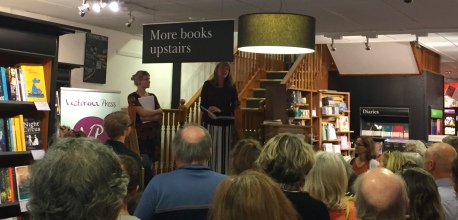
  • invite everyone you know and turn the launch into a party to thank all those who have shown interest in your writing . Make sure there’s plenty of wine and nibbles, and loads of books to sell!

Make the most of opportunities 

  • when I attended a Christmas lunch 2018 with the Society of Authors in Salisbury, I had no idea it would lead to an invitation to deliver a session at the Bridport Literary Festival 2019. Chance meetings are often the best!

Put yourself out there

Book is Judged by Cover-1

  • Press releases have enabled The String Games to feature locally, regionally and nationally in print publications and online features. I’ve also talked on local radio programmes several times. There’s nothing wrong with getting about!

Literary festivals

  • I’ve attended so many festivals as a participant but now I’m a published novelist it’s a delight to feature on programmes as an invited guest. Besides the Bridport Literary Festival, I’ve also delivered input at Sturminster Newton Literary Festival, Blandford Literary Festival and Stockholm Writers Festival. Get me, delivering at international events!

Finge Festivals

  • I write collaboratively as part of 3-She to develop comedy sketches. Last summer we took a show to  Shaftesbury Fringe. There’s such a lot to be learnt from the process of writing with others. Love a good gig!

Curry favour with your publisher

  • I’m delighted that Victorina Press have show confidence and commitment in me as an author and thanks to my publisher, I attended the London Book Fair 2019. My novel is also a finalist in The People’s Book Prize. Covid 19 permitting, there’s a black tie do to celebrate this achievement later this year!
  • The team at Wordsmith_HQ continue to promote my poetry pamphlet adversaries/comrades and share my writing successes across their writing community. Good eggs all round!

Read the rest of this entry »

5 Comments »

Global Day of Solidarity, 22 May 2020

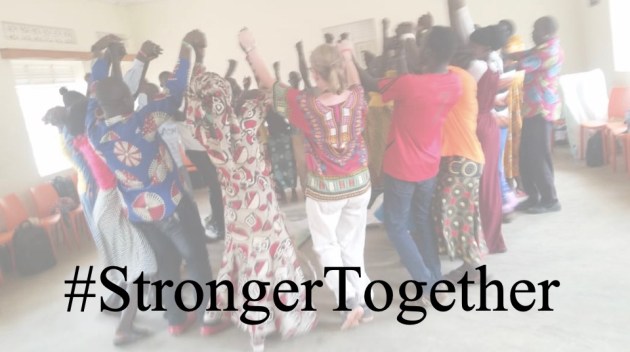
To mark the Global Day of Solidarity returned VSO volunteers were encouraged to post an image on Twitter to convey a message of solidarity with the hashtag Stronger Together.

53A472DB-3A96-497D-B259-7EBE0A573C5C_1_201_a

This is the photo I shared. The picture was taken in Yumbe town where caregivers (teachers of young children) were receiving training on curriculum development. We were actually doing the Hokey Cokey which everyone loved and my colleague, Josephine, took the photo.

I’ve been back from Uganda for two months but my concern for the refugee families from South Sudan I worked with at Bidibidi refugee settlement grows as Coronavirus spreads. Although the Ugandan government has a strong track record of preventing outbreaks, such as closing the international airport on 20 March, the area in which I worked is particularly vulnerable. The settlement is in the district of Yumbe (also the name of the principal town) and is located in West Nile region in the far north-west of the country.  Borders with Democratic Republic of Congo and South Sudan are porous. Uganda has reported only 175 confirmed cases of Corona virus to date, but on 16 May there was a peak in reporting with forty-three new cases, all truck drivers.

In South Sudan there are fears for the spread of Coronavirus with reports that the virus has reached a UN refugee camp in the capital, Juba, where some 30,000 people have sought shelter and protection. One of the country’s four Vice Presidents, Riek Machar (read a little about Riek Machar and Emma McClune here) has contracted Covid 19. According to the BBC, ‘experts worry that decades of conflict has left South Sudan incapable of dealing with a surge in new infections’. There are also fresh outbreaks of violence with about 800 people killed in intercommunal fighting since a new treaty aimed at ending the country’s six-year civil war was signed in February 2020.

All this may have implications for Bidibidi where already the food ratio for refugees has been reduced by 30% which makes it hard for vulnerable families to maintain health and wellbeing. Further restrictions imposed to stop the spread of Coronavirus also impact on the host community. On 18 May 2020, President Museveni announced a further twenty-one day extension to lockdown but with the easing of some restrictions in the coming days and weeks:

  • Private transport with up to 3 people in a vehicle is allowed from 26 May, BUT NOT in border districts 
  • General merchandise shops can open from 26 May
  • Public transport at half capacity allowed from 4 June, BUT NOT in border districts
  • Education ministry to have an action plan by 4 June to restart school in some primary and secondary classes

There’s also published guidance on the use of masks:

In view of the restriction placed on all our lives due to this pandemic, it’s certainly worth keeping in mind the benefits of global solidarity and the message #StrongerTogether.

3 Comments »

Scratched Enamel Heart, Amanda Huggins

Here’s a treat for you. Amanda Huggins joins The Writer is a Lonely Hunter to answer a few questions about her latest (fabulous) short story collection Scratched Enamel Heart.
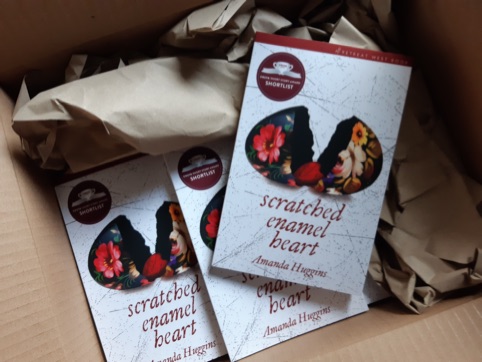
image of book

About Scratched Enamel Heart

A lonely woman spends a perfect night with a stranger, yet is their connection enough to make her realise life is worth living? Maya, a refugee, wears a bracelet strung with charms that are a lifeline to her past; when the past catches up with her, she has a difficult decision to make. Rowe’s life on the Yorkshire coast is already mapped out for him, but when there is an accident at the steelworks he knows he has to flee from an intolerable future. In the Costa prize-winning ‘Red’, Mollie is desperate to leave Oakridge Farm and her abusive stepfather, to walk free with the stray dog she has named Hal.

These are stories filled with yearning and hope, the search for connection and the longing to escape. They transport the reader from India to Japan, from mid-west America to the north-east coast of England, from New York to London. Battered, bruised, jaded or jilted, the human heart somehow endures.

About Amanda

Amanda Huggins is the author of the short story collection, Separated From the Sea, which received a Special Mention in the 2019 Saboteur Awards, and a second collection, Scratched Enamel Heart, which features ‘Red’, her prize-winning story from the 2018 Costa Short Story Award. She has also published a flash fiction collection, Brightly Coloured Horses and a poetry collection, The Collective Nouns for Birds, which is currently shortlisted for  a Saboteur Award.

She has been placed and listed in numerous competitions including Fish, Bridport, Bath, InkTears, the Alpine Fellowship Writing Award and the Colm Toibin International Short Story Award. Her travel writing has also won several awards, notably the BGTW New Travel Writer of the Year in 2014, and she has twice been a finalist in the Bradt Guides New Travel Writer Award.

Amanda grew up on the North Yorkshire coast, moved to London in the 1990s, and now lives in West Yorkshire.

portrait

Questions for Amanda

Your stories in Scratched Enamel Heart are set in different countries and locations. How do you decide on a setting for your story. What is the importance of the place in the development of your story?

It has always been important to me that my fiction has a strong sense of place – something I’ve carried over from my travel writing. Sometimes an idea for the setting comes first, and the story that follows is inspired and shaped by certain aspects of the location. The landscapes and cities in which the stories are set became important characters in their own right. They can reflect emotions or influence characters’ behaviour – such as the way the wait for the monsoon rains affects Maggie’s decisions in ‘A Longing for Clouds’, and the heat and desert landscape have an effect on Miranda in ‘Distant Fires’ – two stories set in the sensory overload of India. Closer to home, a snow-filled London becomes a major character in ‘A Brightness To It’, forming a soft-edged cocoon around the main characters. Two strangers bond in a soulless hotel room after a chance encounter, and are protected from the reality of the outside world by the beauty of their snow-changed environment – yet the city is only temporarily altered, and this reflects their own fragile situation. In ‘Red’, Mollie is trapped on Oakridge Farm with her mother and violent stepfather, and the vast spaces and relentless red dust of the American mid-west are a contrast to her confinement. The open plains and the endless highway offer freedom, yet the landscape is also hostile and bleak, holding up a mirror to her predicament. One of my favourite locations is Japan. My stories are often about displacement and alienation, trying to find connection, about lost characters in big cities. This can go hand in hand with the notion of things never being exactly as they seem, of them being a little off-centre, misunderstood, or lost in translation – and Japan is the perfect backdrop to reflect that.

The stories in Scratched Enamel Heart range in length from a single side to several pages. How do you decide the length of each story?

It’s not often that I set out to write a piece of fiction of a particular length. I’m usually exploring an idea without knowing where it will take me – it could end up being 300 words or 3000 words. Sometimes, when a longer story isn’t working, I find it can be pared right down to a one-page story that works much better. However, I am writing longer stories most of the time right now, and in doing so I seem to be going against the trend. As more writers are turning towards short flash pieces, I find I’m leaning towards longer fiction!

Congratulations on signing with Victorina Press for the publication of your novella. It’s good to have you onboard as a fellow Victorina Press author. You’ve also had a collection of poetry recently published, the wonderful The Collective Nouns For Birds. What’s it like being a writer of short fiction, long fiction and poetry? How do you manage your time?

Thanks, Gail! I’m already enjoying working with the Victorina team – and it’s lovely to share a publisher with writers I know, such as yourself and Chris Fielden. All our Squandered Beauty is my first novella, and is based around the title story from my first short story collection, Separated From the Sea.

The Collective Nouns for Birds began to take shape when I was snowed-in at a cottage in the North Pennines. I didn’t plan to write a collection – I was just feeling my way at first, as I hadn’t written any poetry since my late teens. However, I discovered I really enjoyed writing it, and the poems started to come together as a loosely themed body of work. A review by Amanda McLeod sums it up better than I can:  “Huggins explores…all the ways in which we lose things, the clarity and sometimes sadness that retrospection can bring. There is the transition from childhood to adulthood, the parting of lovers and friends, loss of life, of special places.”

I don’t think poetry and short fiction are always that different from each other. My prose style leans towards the lyrical/poetical, and I tend to write narrative poetry, so for me there is a real crossover between the two forms. Sometimes a poem will morph into a short story and vice versa – there are a couple of poems in my collection which also feature as flash pieces in Scratched Enamel Heart.

Longer fiction is a relatively new direction for me, and once again it’s something that has come about by accident rather than by design. Both my novellas have developed from short stories, and in each case it was because several readers wanted to know what happened next after those original stories had ended.

I sometimes find it difficult to manage my time – especially as I have a day job four days a week – but once I’m committed to a project then I always finish it before moving on to the next thing. I already have a ‘next thing’ in sight actually – and it may well turn out to be the longest writing project I’ve undertaken to date!

Wow, Amanda. You are so prolific. Good luck with your next project!

If you’re interested in learning more about Amanda, you can read a previous interview here.

Where to find Amanda

@troutiemcfish

https://troutiemcfishtales.blogspot.com/

Where to purchase Scratched Enamel Heart

Available from 27 May from Amazon 

image-2

My review of Scratched Enamel Heart

This short fiction collection contains twenty-four emotionally-charged stories that take readers on a journey to households and communities in a range of countries. Through these stories, Amanda Huggins cleverly shows us the commonality of emotional experience. That feelings of isolation, love, grief, loss and regret occur in different backgrounds and cultures. And equally, that hope and the promise of a fresh start is possible. Amanda Huggins writes in a beautiful and empathetic way to immerse readers in the challenges and dilemmas she presents to her characters. As readers we care about these characters and learn from them. This is a truthful, authentic and essential read.



1 Comment »

Woman on the Golden Hind

I’m reading a fascinating novel just now. It’s On Wilder Seas by Nikki Marmery. What an absolutely fabulous cover!

51bDFWEpQNL._SX324_BO1,204,203,200_

The narrator is Maria, an enslaved woman who shares her experiences of living on the Golden Hind for nine months.  Meticulously researched, Nikki Marmery allows Maria to live and breathe where nothing is noted about her in the records besides the dates she boarded and left the ship. The action takes place in 1579 during Francis Drake’s circumnavigation voyage.  Maria is a lone woman amongst eighty sailors. Determined to become free, Maria uses tenacity and quick thinking to her advantage.

golden-hind-219818__340

Many of you will know there is a reconstruction of the English galleon that has been  berthed at St Mary Overie Dock in Southwark since 1996. Whenever I walk past this full-size reconstruction of Golden Hind I am reminded of how compact the ship appears. Goodness knows how Maria coped! Since the launch of the  reconstruction in 1973, the galleon has sailed  more than 140,000 miles to San Francisco, Japan, the Caribbean and other destinations.  Impressive!

SWF

I will be interested to meet Nikki Marmery online when we appear alongside Karen Havelin on the Debutants panel at the Stockholm Writers’ Festival on Friday 22 May 2020. We are all previous attendees of the festival and have had our debut novels published in the last year. Join us at what is now known as the #StuckHomeWritersFestival here.


1 Comment »

E-volunteering and working as an author

Now that I’ve returned to the UK from my VSO volunteer placement at Bidibidi refugee settlement in Uganda, I’m getting back into the swing of my writing life. You can read about how I am collaborating with illustrator Fiona Zechmeister on a children’s picture book called Pan-de-mo-nium here. But I’m not yet willing to relinquish my experiences in Uganda, so I’m very pleased to share the news that I’ve been appointed as a Psychosocial Support and Emotional Learning Expert E-volunteer. This appointment followed an online application and interview. I have a job description and an E-volunteer agreement which last six months and is renewable. I am very impressed with the thorough application process and the support offered by VSO in my new role. I’m also finding this work dovetails very well with my current writing project.

As part of my E-volunteer responsibilities, I’ll co-ordinate a task group with a focus on mental health, psychosocial support and emotional learning to help children and families in the poorest countries. Proposed work includes adapting advice material for parents to support the emotional wellbeing of young children during the Covid 19 lockdown. Already there is very relevant material published to support parenting, please see an example poster below:

english-tipsheet1-updated

There are six posters altogether covering issues such as managing behaviour and providing structure for children during the Covid 19 lockdown. Click here to access these in a worldwide range of languages.

I’m also part of a storytelling task group and from my experience as an author of a children’s picture book, I hope to contribute fully.

During the Covid 19 restrictions, there are challenges in terms of coping with lockdown but also opportunities in extending virtual support to others. It’s a time of working out what’s important as an individual, as a family member and as part of a wider community.

How have you found Covid 19 has affected your outlook?


5 Comments »