If you’d like to find out more about the background to This Much Huxley Knows (and much more besides) do pop over to Boomers on Books. Just click the link!
Writing plates are spinning
I’m currently in the fortunate position of having a debut novel published, a children’s picture book under contract, a novel on submission and a new work-in-progress. My time is carved up between marketing and promoting The String Games, sending out submission packages for This Much Huxley Knows, finalising the illustrations for Pan de mo nium and cracking through the first draft of Little Swot. It’s just as well my only other commitment is ten hours a week e-volunteering with VSO. Some days it feels like my feet hardly touch the ground but I’m not complaining.

Does this girl look like a little swot?
With all of these plates spinning, the real excitement is my new work-in-progress Little Swot which is quite different from my other manuscripts. The idea came from evenings in Ugandawhen I was too tired to read, too hot to sleep and so listened to podcasts. I’m writing one thousand words each day which soon adds up and I’m now over half way through the story and pleased with my progress. I’ve written a synopsis so I know what’s going to happen and I’ve played around with ideas for pitching the novel to publishers when the time comes.Indeed, I’d love to receive some feedback from you. Do you think this novel idea has legs?
E-volunteering and working as an author
Now that I’ve returned to the UK from my VSO volunteer placement at Bidibidi refugee settlement in Uganda, I’m getting back into the swing of my writing life. You can read about how I am collaborating with illustrator Fiona Zechmeister on a children’s picture book called Pan-de-mo-nium here. But I’m not yet willing to relinquish my experiences in Uganda, so I’m very pleased to share the news that I’ve been appointed as a Psychosocial Support and Emotional Learning Expert E-volunteer. This appointment followed an online application and interview. I have a job description and an E-volunteer agreement which last six months and is renewable. I am very impressed with the thorough application process and the support offered by VSO in my new role. I’m also finding this work dovetails very well with my current writing project.
As part of my E-volunteer responsibilities, I’ll co-ordinate a task group with a focus on mental health, psychosocial support and emotional learning to help children and families in the poorest countries. Proposed work includes adapting advice material for parents to support the emotional wellbeing of young children during the Covid 19 lockdown. Already there is very relevant material published to support parenting, please see an example poster below:

There are six posters altogether covering issues such as managing behaviour and providing structure for children during the Covid 19 lockdown. Click here to access these in a worldwide range of languages.
I’m also part of a storytelling task group and from my experience as an author of a children’s picture book, I hope to contribute fully.
During the Covid 19 restrictions, there are challenges in terms of coping with lockdown but also opportunities in extending virtual support to others. It’s a time of working out what’s important as an individual, as a family member and as part of a wider community.
How have you found Covid 19 has affected your outlook?
The high points and pitfalls of volunteering overseas
There is plenty to enjoy about my placement with VSO. The organisation has a thorough recruitment process, there’s excellent training before departure and throughout the onboarding period of preparing to leave the UK, I felt very well supported. On arrival in Uganda, there was a delay in arriving in at my placement, but I joined VSO team building in Mbale, had time to relax in Gulu and went on a river cruise and safari at Murchison Falls National Park.
I was appointed as a psychosocial and child protection volunteer at Bidibidi refugee settlement and joined an excellent team of experienced practitioners who support seven Early Childhood Care and Education centres in Zone 3. I love working with my colleagues and have learnt so much from them. One of the first learning points was to adjust my use of English to make it ‘easy to hear’ for host and refugee families. I copied my colleagues’ patterns of speech to make my utterances more like standard Ugandan English. The key is to speak slowly, emphasise key words and always avoid unnecessary language. For example, Ugandans say ‘you come’ rather than ‘can you come here?’ It is a language of imperatives. I enjoy this direct way of speaking and find some of the vocabulary charming. If you need a ‘short call’, you’ll be directed to the toilet or latrine. And ‘to pick’ is a high frequency verb because it means to choose, to collect, to take or to pick depending on the context: it’s the job of young girls to pick firewood on the settlement. I also much admire the training my colleagues offer to a range of audiences. There is always humour in their delivery, time for laughter and a joy in sharing anecdotes.
My experience of delivering training to refugee and host community parents living on the settlement has been positive. Although the groups have been huge (over one hundred parents in some villages) I have been able to explain the need for parents to support the psychosocial wellbeing of their children (with the aid of interpreters). Further sessions are planned to focus on developing constructive patterns of talk with young children and the need to play with children to build family bonds. Many of the parents on the settlement have known no other existence besides living in conflict and displacement. Their skills and confidence to parent effectively have therefore been diminished, sometimes due to the lack of good parenting they received. My input aims to break this intergenerational cycle. It is rewarding work.
The most difficult part of my placement is getting used to living in Yumbe. I don’t think I was adequately prepared for what to expect. There is very little information about Yumbe on the internet and although I asked everyone what they knew the place, I only ever got two responses: the road is very bad and it is very hot. Yumbe is a town with limited resources, poor transport links to other destinations and few social outlets. I guess this only to be expect – refugee settlements aren’t normally found in desirable locations. Other NGOs classify their projects according to the hardship of the placement. Refugee camps in Syria are classed as hardship 3 area. Yumbe falls just below this at hardship 2 category. This means that accommodation for staff and volunteers at some NGOs compensates for the hardship of the placement. Friends live in comfortable accommodation with air conditioning, a generator for a constant supply of electricity and water tanks to ensure the availability of piped water. Others (including two of my colleagues) spend Monday to Thursday in Yumbe then return to the relative luxury of Arua each weekend. This week I experienced a twenty-four hour power cut (which meant sleeping during the hot night was impossible without a fan) and photocopy resources for training sessions was problematic. There is a water shortage in Yumbe during the dry months of January and February. Although where I live has a water tank, for some reason it was not supplying water this week and I had no access to piped water from Monday to Friday. Fortunately, I was able to return to the hotel where I stayed during the initial period of my placement and used the shower facilities there. (I won’t go into details about the difficulty in living for that period with a non-flushing the toilet – too unpleasant.)
A week at Bidibidi
Now that I’m feeling more confident in my role as a VSO volunteer with Early Childhood Care and Education (ECCE) at Bidibidi refugee settlement, Uganda, it’s about time I introduced the team. My colleagues include two exceptional practitioners who have substantial experience in teacher education. They are national volunteers, Zachary Alio and Josephine Lubwama. Both have come out of retirement and have given up the comfort of their family homes to support the children of refugees from South Sudan and national families living in the far north west of Uganda. We work under the guidance of our team leader, Christine Abala who offers brilliant direction and support. Christine has a background in social work so she is very well placed to advise on the needs of vulnerable children.

Josephine, Christine and Zachary
I am so impressed with the work my colleagues are doing in training, mentoring and supporting refugees and and local Ugandans to act as caregivers to young children attending ECCE centres. The caregivers are fluent in English and the local language of Lugbara or Bari which is the name for a group of South Sudanese dialects. The caregivers are educated to the standard required for students entering teacher training, but few have formal teaching qualifications. Therefore, the support offered by Josephine and Zachary is essential to ensure the safety, learning, play and wellbeing of children from 3–6 years enrolled at the seven centres in Zone 3, Bidibidi. You can read more about the settlement here.

Josephine training the caregivers
The caregivers attended refresher training delivered by Josephine this week. The session involved planning of learning according to the National Early Childhood Development Framework. I loved the way Josephine offered training – it was full of empathy, passion and humour. Such a shame I couldn’t stay for the whole day, but I had learning to deliver as well.
My role at Bidibidi relates to psychosocial wellbeing. UNHCR uses the term mental health and psychosocial support to describe “any type of local or outside support that aims to protect or promote psychosocial wellbeing or prevent or treat mental disorders.” As I am working with young children, I started my programme of activities by delivering an introduction to the psychosocial support parents can offer their children in the home. This involved a two-hour session at each of the seven centres. I was ferried around the settlement by motorbike on some days, by a four-wheel drive vehicle on others. It was great fun working with the parents and the turn out at some villages was over one hundred and twenty people. (I shall never again have anxiety about addressing large groups!)
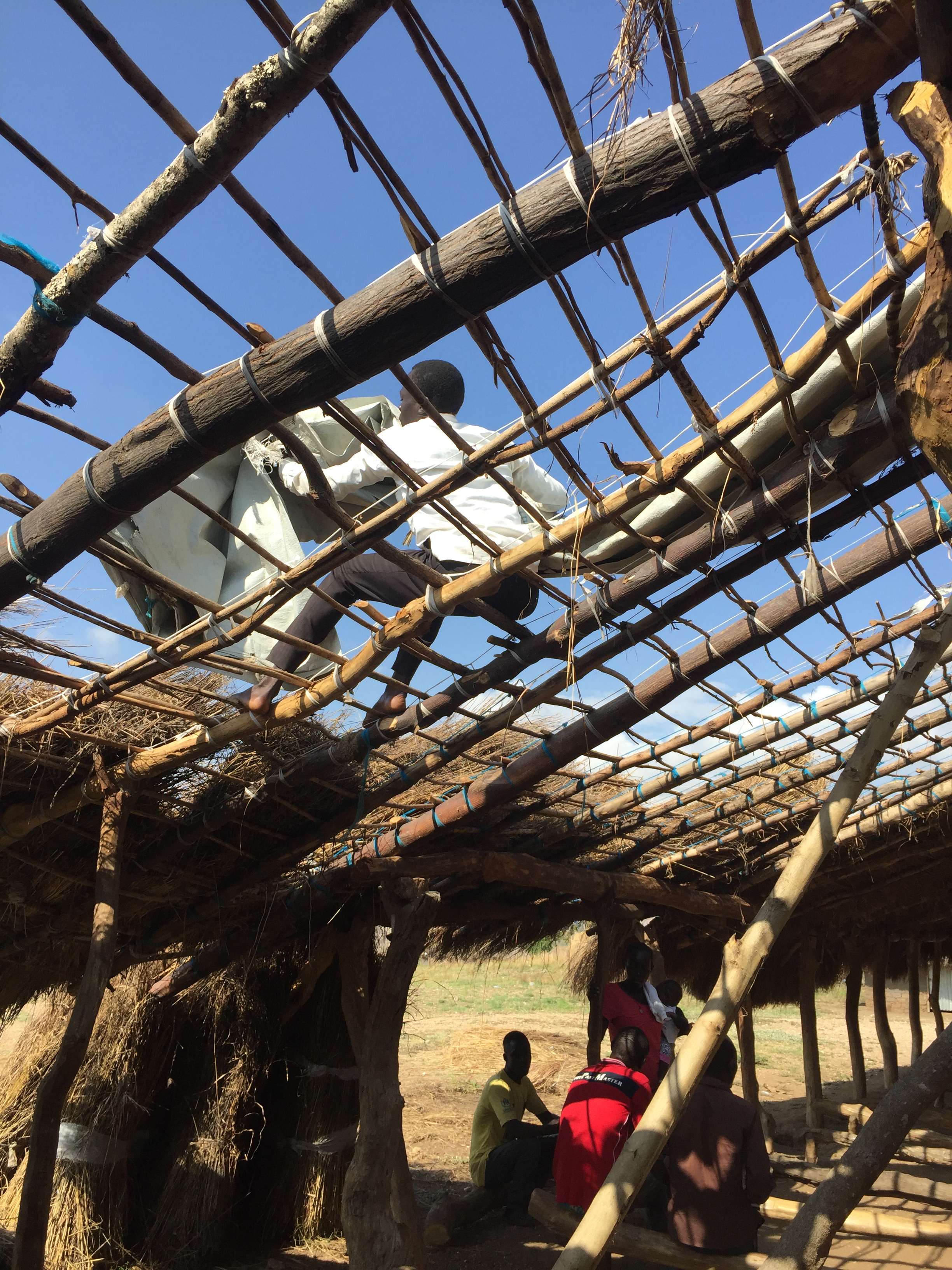
Temporary roof repairs meant everyone could sit in the shade.
Delivery of the training I had planned was challenging because everything I said needed to be interpreted by volunteers into the local language and Bari. I had to do a lot of thinking on my feet when the interpreter’s grasp of English was more limited than I had expected. Although the flip chart displays I had prepared included illustrations, the language was too advanced, so I had to adjust my talk to avoid use of technical language, complex sentence constructions and colloquialisms. The other problem with using flip chart paper was the wind. Most of the venues were church buildings with thatched roofs and half walls. I had to chase after one of my sheets when I gust took it! Everyone laughed, thank goodness.
Meandering and thinking: a post about Idi Amin, chapatis and red dust

Christine, ECCE project leader, reads my office display about systems to support violence free lives
I walk to the VSO office in Yumbe each morning. Often it’s an early start because it takes an hour to drive to the distant villages in zone 3 Bidibidi, where the Early Childhood Care and Education Centres are located. It feels like I’m a minor celebrity as people call out ‘Sister, good morning!’ and I return the greeting. During the last couple of days there’s been rain in Yumbe, which is unusual for this time of year. December, January and February are known as the sweltering season with rain arriving in March. I’m told February is the hottest month and temperatures reach up to 40 degrees. When it’s hot and dry, the red dust is a real nuisance. It stings my eyes and gets between my toes, even when I’m wearing trainers. I’m very glad of the eye drops and athlete’s foot cream I brought with me.
It gets light in Yumbe around 7am and and that’s when I take the opportunity to have a run around the town. Usually goats are the only obstacles but on this occasion they sheltered under a porch.

Goats are seen as a wise investment for refugee families living on the settlement. If they are able to earn some shillings, for example, from making bricks out of soil and water for house building, the money raised can be put towards buying a goat. The animal is then fattened and kept until a big expense arises. School uniform, the voluntary fee imposed by school PTAs and supplies of school equipment are a major concern where families have several children.
In restaurants all over Uganda, goat meat is on the menu. We ate it at the VSO team building barbecue in Mbale back in December, and I’ve seen goat curry on offer in several hotels I’ve stayed in. It’s interesting that the food of the Asian minority (who where expelled from Uganda in 1972 by Idi Amin) remains popular. Vegetable and beef samosas are available everywhere and chapatis are cooked but served differently to Indian ones. In Uganda, chapatis are rolled into a cone with the outer layers brushed with oil.
Asians, mainly from Gujarat, settled in Uganda during the time of the British administration. By the 1970s many ran businesses or farms. When Idi Amin issued the notice of expulsion they had only ninety days to leave the country. Asians were forced to abandon their properties, cars and possessions. Businesses were reallocated often to people who had no experience and these subsequently failed. When President Museveni came to power, he invited Gujaratis to return to Uganda and many took up the offer.
Idi Amin was from West Nile, the region where I’m currently based. To reach Yumbe, you drive through the town of Koboko, the place of Idi Amin’s birth. This is also where the sealed road ends and the journey across red dust begins. Oh dear – it seems we’re back to red dust again. Even the forecourt of the petrol station in Yumbe is made of the stuff. And this is one of the final landmarks on my walk to work.

Bidibidi Refugee Settlement
It’s been a long time coming, but I finally made it to Bidibidi refugee settlement earlier this week. I was a pillion passenger on this off-road motorbike.

Mine is the black, white and red helmet and I was very glad to wear it. The road from Yumbe is unsealed and the red dirt is so rutted that in places it felt as if we were driving over corrugated iron. I was surprised I didn’t crack any of my teeth from the juddering! Other times, we skirted around massive holes and rode up and down hills. My arms ached from holding tightly to the passenger handgrips and my thighs aren’t used to being stretched over a seat for what turned out to be an hour long journey to Zone 3. There are other hazards on the road, too. Whenever overtaken by a car or truck, dust swirls into a plume of red and visibility is significantly reduced. I didn’t realise cattle were such a liability – they always have right of way.
We arrived at village 16, where a temporary structure has been erected for the VSO Early Childhood Care and Education (ECCE) centre that caters for children from three to six years. It only requires flooring to be ready for the new school year which starts at the beginning of February.


This morning I was working with my colleague Zachary to prepare training materials that will enable parents and caregivers to create displays and learning resources for the centre.
The village was almost completely deserted but for this woman cooking beans on a fire. She laughed when I asked to take her photograph, but I loved her colourful clothes.


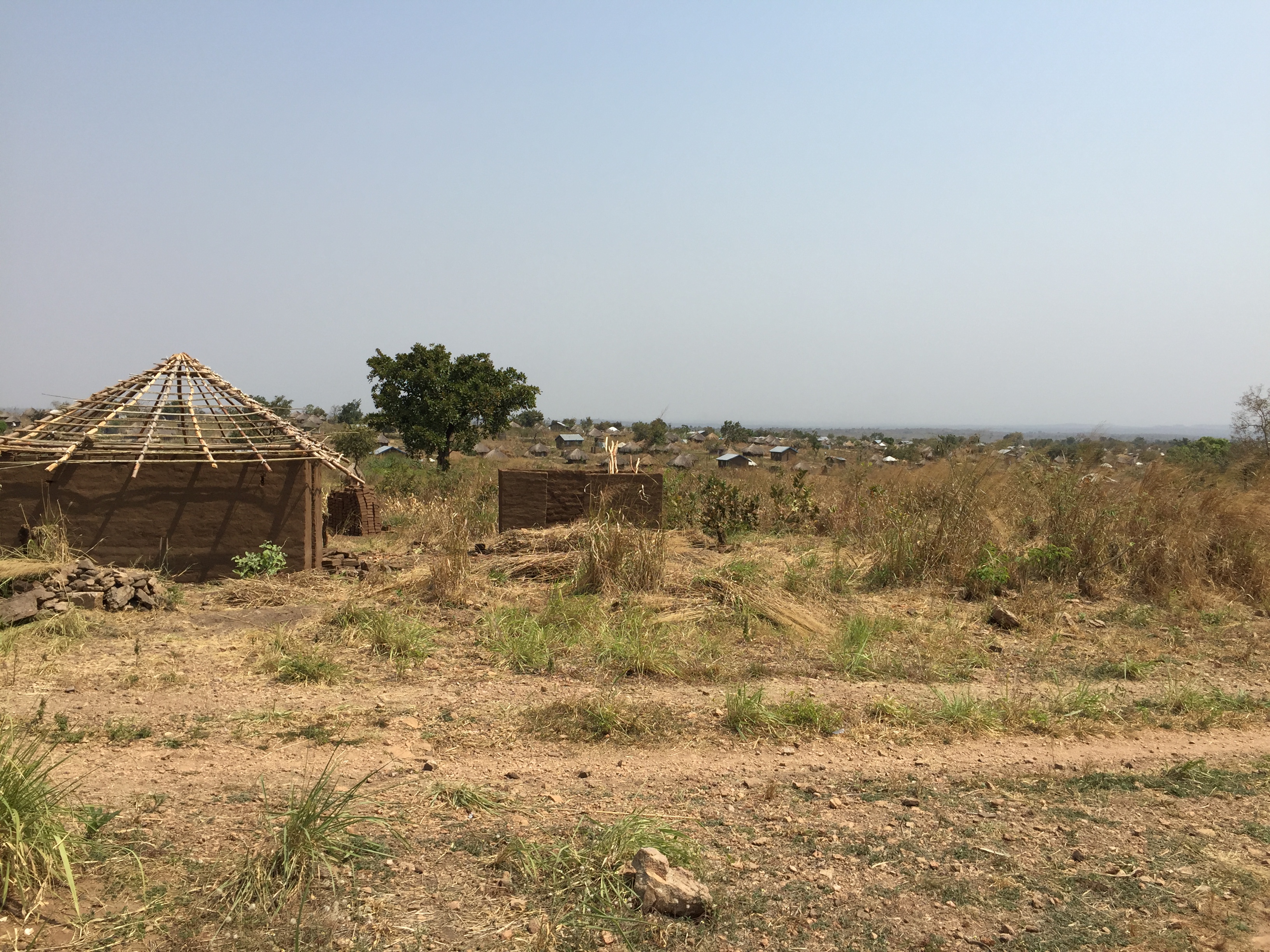
It turned out that most of the residents were at a workshop offered by an NGO at a nearby primary school. The organisation was promoting the use of briquettes to prevent conflict over firewood which is an ongoing issue at the settlement. Refugee women feel vulnerable while collecting firewood and accuse men of the host community of gender-based violence. The Aringa men claim they have been misunderstood as there is no shared language between the refugees and the host community. But they also need firewood to make charcoal and refugees collect it for cooking purposes. Firewood is a resource that is becoming more scare due to the 230,000 refugees that now live amongst the host community in the 250 square kilometre area that until the arrival of refugees was regarded as ‘hunting ground’. However, since 2016 when refugees first came, each family are given a plot of land with the expectation they will build a house and grow vegetables. The land around the villages in Zone 3 has such rocky soil it would seem impossible to grow anything and therefore refugees are dependent on food aid.
We next went to village 15, where with the help of a megaphone, one of the community leaders alerted parents and children to our presence. The group comprised many children with disabilities, from hearing and sight loss, to speech and mobility issues. My colleagues are so concerned about the number of children with disabilities who are not receiving education or healthcare, we have developed a new enrolment form for 2020, which includes the Washington Group of Questions. By posing these questions to parents, it is hoped we can develop a database to share with health professionals so that children can receive the aids they need to enable access to education.
While I was with the parents and children, I decided to do share a story and used a rainbow string to help in the telling. String games are international and parents within the group were able to make the complicated figures that I struggle to produce.


The following day, Zachary and I visited village 11 where the temporary structure requires tarpaulin walls as well as a floor. Until the centre is ready, the four to six-year-olds meet in a church building while the three-year-olds play and learn under the shelter of a tree. The staff at the centre are keen to get back to work. I was so impressed with their team work, their ability to galvanise parental support and their commitment to the children in their care. Such a fantastic group of caregivers from both host and refugee communities, that I had to take a photo.

I’m now approaching my first weekend in Yumbe. My colleagues are with their families in Arua and Kampala so I am alone. But I have activities to plan and writing to do, so I won’t mind too much.
Safari in Murchison Falls National Park
Although it’s never been one of my burning ambitions to join a safari, I’m very glad I did. Murchison Falls National Park is about three hours drive from Gulu and while Sjarlot and I had time off from our roles as VSO volunteers over the Christmas break, we made the trip along with Helen, Sjarlot’s daughter.

We visited the national park three times and I was amazed each time at how the outlook changed according to the time of day. Sunrise gave a pastel hue and the chance to spy a small herd of elephants.

Later in the morning, there was a hint of blue as a bird took rest on the back of a water buffalo.

The evening light gave a honey glow that made our guide convinced there was a lion resting in this tree. He even went off road to check but in the end we saw no lions.

Elephants plodding along made me laugh.

And giraffes were endlessly elegant in their manoeuvres (apart from when squatting for water).

At the campsite, there was even a chance encounter with a grazing hippo!

So if you find yourself in Uganda, the national park at Murchison Falls is a great way to spend a couple of days.

Now we’re in Kampala joining training in communications and media. Here’s a photo of the sunrise.

Tracking back to find the root of an idea
It’s long been my ambition to volunteer with VSO International. I received the vacancies newsletter for many years and have enjoyed browsing the range of educational opportunities available for one or two years. The problem has always been I can’t commit to that length of time. My husband has no interested in joining me, so I figure that if I want to stay married, the longest I can be away for is a few months. Back in the summer I noticed a position in Ethiopia working at a teaching training institution from April 2020 for six months. At last my time had come. I spent a couple of days working up an application and when I came to submit, the vacancy had vanished. After getting all fired up about this new possibility, I searched the VSO website for any other potential jobs and submitted several applications.
A few weeks later, I was invited to a Skype meeting for screening. Once successfully through this, it was explained that I needed to pass a situational online test and a panel interview to join the VSO bank, where I could wait for up to eighteen months for a short term vacancy to arise. My details would then be submitted to the country office for a further interview. During October, VSO suggested I apply for the post of protection and psychosocial support specialist working with early childhood care and education centres at the Bidibidi refugee settlement in Uganda. The position had originally been for one year but as funding was due to end in March 2020, this made a perfect short term position for me. I applied, was interviewed and offered the post to begin 8 December 2019.
This role really appealed to me because I had spent several years in Wandsworth working as an advisor for refugee pupils. During that time my work involved curriculum development to promote a greater understanding of the plight of refugees. The aim of these sessions was to enable pupils in mainstream classrooms to develop greater empathy and understanding for new arrival children from refugee backgrounds. One of the resources I used was a publication called One Day We Had to Run! which collected the stories of unaccompanied boys fleeing war to find safety at the Kakuma refugee camp in Kenya. The boys were also encouraged to share their memories, experiences and hopes through painting. The material for the book was collected by Sybella Wilkes, then a young aid worker at the camp who now works as the senior communications officer with UNHCR. I remember thinking at the time that this was a great thing to do and I wondered if there would ever be an opportunity for me to do something similar. And so, I guess the seed or an idea or ambition was sewn.

When I thought about this further, the actual ambition to volunteer with VSO goes back much further. I lived in Papua New Guinea for two years following marriage to my first husband in 1982. Tom got a job in Wabag, Enga Province and I accompanied him there. While he trained a National team at the Department of Works and Supply, I volunteered at a pre-school. Amongst the expatriate community in this far flung town was a Caribbean poet called Archie Markham. He was a VSO volunteer attached to the Department of Information as a media coordinator. As a working poet, he also established a series of poetry readings which became a highlight for the community. He went on to write a memoir of his time in Wabag titled Papua New Guinea Sojourn: More Pleasures of Exile. It seems to me, this is the deeper root of my wish to become a VSO volunteer. It’s possibly something to do with reclaiming that young woman I once was and combining it with the experience of my more mature years as a teacher and writer. Who knows? Like Archie I may find inspiration to write from working with refugee families at Bidibidi.
Before I get ahead of myself, it’s important to remember I’ve only been in post for two weeks. The in-country orientation in Kampala has involved briefings on the role, an introduction to administration systems, IT support and health and safety. Accommodation has been found for me at my placement and I’ll be joining my new colleagues at the office in Yumbe on 6 January. In the meantime, I’m staying in Gulu over the holiday period which will give me a chance to obtain furniture and furnishings for my new temporary home as well as celebrate Christmas with other VSO volunteers. Although there’s a lot going on at the moment, it doesn’t stop me from looking forward to starting my role at Bidibidi.
Relationship Strings
I spent the weekend at the VSO offices in Kingston with nine other international volunteers. We took part in facilitation training to assist in the development of our roles at educational settings based in Myanmar, Rwanda, Nepal, Malawi and Uganda. What a lovely bunch of people! Our WhatsApp group is now buzzing with feedback.
One of the things we educationalists find it hard to get our heads around is the idea of ‘passing the stick’. That is, we should adapt our ways of working so that we allow participants in our programmes to take a lead on how input should be focussed and which ideas and strategies to share and develop. As teachers, we’re too used to coming up with questions to solve, but for ownership of the process, participants need to be fully involved with identifying the areas of learning and routes to acquiring skills and confidence.
Many of you will know, I like using string so much I named my debut novel The String Games. But string is also an accessible learning resource available anywhere in the world and can be used to facilitate discussion. As a mixed group of people, the purpose of my activity was to shed light on the things we held in common. Following the directions in the participation manual, we sat in a circle on the floor and as the holder of the ball of string, I was the first to speak. I held the end of string and rolled the ball to someone who I knew I shared something with, saying their name and what we had in common. It could be that we’re both mothers, teachers, shop in the same stores, like the same food … anything really. Upon receipt of the ball, the next person hooks the string over their finger and rolls it to someone else, saying their name and the thing they hold in common. In this facilitation, I appointed roles to each of the participants so we could imagine the activity being delivered on my placement at the Bidibidi refugee settlement in Yumbe, Uganda. You can read more about the context of my placement here.
The photo below shows the string pattern that was produced as part of the activity, illustrating the links between members of the group. In terms of using this on my placement with members of host and refugee communities, it could prove to be a useful tool to inform analysis and planning.

Another way to use a ball of sting in participatory training is to sit in a circle and roll the ball from participant to participant whenever they wish to speak. Holding the ball of string gives a platform to the speaker and avoids interruptions. The web that is created by hooking the string after turn taking demonstrates whether all have contributed to the discussion and whether certain members have dominated. I’m keen to try this activity at some point. Thanks to trainers Wim and Sue for their input over the weekend and to everyone on the course for their friendly support, ideas and encouragement.
My departure date for Uganda remains unconfirmed but as soon as the visa is sorted, I’ll be off.


 the writer is a lonely hunter